The folks over at Free Novel List are running a sweepstake. The winner gets 7 free books. You get 7 more free books just for entering.
You also end up subscribing to their newsletter mailing list. I use a throwaway address for such things.
Author W.J. Lundy has a couple books in the mix. I thought his first book was a little weak (1 star), but it showed some promise. His second book was quite a bit better (3 stars).
There are a couple other authors in the mix that are worth considering as well.
Wednesday, April 19, 2017

Review: Tales of the Forgotten by W.J. Lundy
 Tales of the Forgotten by W.J. Lundy
My rating: 3 of 5 stars
I gave the first WTF novella one star. I had this one at two stars right up to the end.
If you have some military service, then this is a good book to read. You will bring to the book your knowledge and past experiences of small unit interpersonal dynamics. You will being your perspective of being deployed or otherwise kept from your family due to operational commitments. You will understand the many motivations that people have for serving, working together, and striving for excellence.
And it is a good thing that you will bring that personal history to the book because it is pretty much assumed that the reader understands these aspects of military life.
The book suffers from a lack of character development.
The characters are little more than cardboard cutouts. More effort is put into describing weapons and tactics than into developing each character's motivations and thoughts.
It reads quite a bit like a pretty good plot development piece for a movie. I think it might make a pretty good movie.
It just isn't that great of a book.
S/F
Dann
USMC 1984/1992
View all my reviews
Monday, April 17, 2017
Review: Brother Dust: The Resurgence by Steven Beaulieu and Aaron Hall
 Brother Dust: The Resurgence by Aaron Hall
My rating: 3 of 5 stars
Brother Dust by Steven Beaulieu and Aaron Hall
3/5 stars. This was a strong 2.5+ star experience.
Brother Dust is properly classified as "science fantasy". The events in the book take place among a spacefaring society. However, the amount of actual science involved is negligible.
The book details the continuing travels of the Solovat empire. The Solovat home world has become infected with some sort of planet killing virus. This virus consumes a planet's "energy". To save their home planet, the Solovats roam from world to world mining each planet for its "energy".
They drill ever deeper into each planet core gathering planetary energy that is then transmitted to Solovat. Once the core has been breached, the planet dies and any remaining energy is sucked off to the Solovat home world. Also, a fair amount of the advanced Solovat technology also uses this planetary energy.
Brother Dust is born on a world that has been prematurely consumed as it is breaking apart. The native inhabitants of that world seem to reflect the native foliage is a sort of chameleon-like behavior. But as the world is broken, it is mostly just dust.
What follows is a meditation involving several different themes. One theme has to do with the environment. Another prominent theme is the relative merit of empires.
Against those themes unfolds the story of a Brother Dust who transitions from enforcing the Empire against a series of unfortunate civilizations to a Brother Dust that seeks to force the Empire to leave the Dastropian civilization alone. He ends up aligned with a nascent rebellion movement.
Brother Dust is so named because he can stop appearing as a Solovat. Instead, Brother Dust can become "dust" that is nearly impossible to kill and is exceedingly effective as a weapon that shreds the lungs of Solovat soldiers and can open doors by slipping through the slightest of cracks. Brother Dust discovers that there is a cure for his "condition". Having lived for so long as dust, Brother Dust gladly accepts this cure that must be re-administered every few days.
The first roughly half of the book is quite good. It is well paced and well written.
The latter half of the book turns cartoonish with Brother Dust turning into more of comic book superhero. Extensive narrative is used to describe fight scenes with round-house kicks, thrown punches, and foot sweeps. The rebellion decides to avoid using lethal force for some reason. Brother Dust continues to accept his treatments despite the fact that they severely limit his ability to fight. Characters start using persuasion in the middle of gun fights, fist fights, and fighting fights.
I dropped out of the narrative at this point and began looking at flaws in the plot and counting the number of instances of poor grammar. Both were found with little trouble. Some of the worst examples involved characters barely limping out of one scene but being able to beat fresh (and unwounded) opponents in the next scene. It takes longer than an hour or two to recover from significant wounds.
Brother Dust suggests that these authors have much to offer in terms of telling a compelling story. It also suggests that they have much to learn about it as well.
View all my reviews
Monday, April 10, 2017
Review: Darwinia by Robert Charles Wilson
 Darwinia by Robert Charles Wilson
My rating: 3 of 5 stars
3/5 stars. I'd call it 3.5 stars. Just a little short of what I'd call a 4-star book.
Darwinia has one foot firmly planted in the early 20th-century western culture and the other foot planted.....somewhere else.
For the first half of the book, we follow various characters as they navigate a world where the better part of Europe and the UK have been replaced by an alternative biome. Geographically the "new" old world is close to the same. Rivers make bends at different places. Bogs and marshes appear in different places. Mountain ranges rise up in a familiar but not quite identical fashion.
There appear to be ancient remains of creatures unlike anything previously seen by humanity.
The world is in shock. British citizens around the world work to return to what was formerly Britain to rebuild what was lost. Citizens from various European nations do the same thing, but with less enthusiasm and effect.
With the loss of Europe, including Russia, America is left as the sole power in the world. The American government has decided that this "new" old world should be open to all for settlement rather than remaining the province for European expatriates to re-settle. A low-level conflict ensues.
Instead of trench warfare on a massive scale, we instead see a low-intensity conflict conducted that mainly involves small-scale raids. History has changed, but it still echoes.
And that is where the foot planted firmly somewhere else comes into play. Just when you think this is another alternate history tale, you discover that it is something else. Something more.
Something that involves conflict on a much grander scale.
I found the concept to be interesting. The characters were engaging and the events kept me coming back. The hook...that conflict on a grander scale...just lost me a bit. After the first half of the book intimating questions about religion and evolution, the shift was not only jarring, it undermined the earlier philosophical debate.
Curiously, this was a finalist for the Hugo award for best novel in 1999. This wouldn't be something that I would select for that level of recognition.
View all my reviews
Review: Servant: The Awakening by L.L. Foster
 Servant: The Awakening by L.L. Foster
My rating: 3 of 5 stars
L.L. Foster's Servant: The Awakening is the best book that I did not finish. I'm giving it 3 stars in this review.
The premise is straightforward.
God...or "god"...or "something" periodically compels our heroine, Gaby, to destroy demons. A feeling comes over her that is both painful and undeniable at the same time. The pain remains until the demon is dead. Or sent back to hell. The early part of the book is unclear on the religious connections involved.
At the start of the book, the characters bore more than a modest whiff of cardboard. Gaby is an angry loner. That's all you get; anger and purposeful separation from the rest of humanity. She doesn't understand why she has to kill these demons and she doesn't like the compulsion to kill them either.
Her landlord has poor self-esteem. Mort is just wishy-washy in every aspect of his life and relationship with others.
Then there is the handsome and dashing police Detective Luther. The good detective inspires feelings in Gaby. Feelings that she doesn't want to have. He is a bit of a mystery as he keeps showing up at all the wrong/right times. And Gaby experiences an unexplainable attraction to him that also messes up her demon-killing skills.
All very cardboardery. But then midway through the book, the interaction of the characters, as well as the developing threat of a continuing stream of new demons, starts to make things interesting. I bought this book at a Dollar Store and it could have been easily worth the original cover price in terms of entertainment.
The problem....cancer. The hook in the book is that all of the demons end up possessing cancer patients. The villain, in this case, is using the patients as potential hosts for the demons. Instead of doing his job and curing the patients, he is actively making it worse.
And I couldn't finish the book. I've lost too many people to cancer. Seeing their pain as a pathway to demon possession isn't fun for me. I think the book has some potential as the characters start to unfold. I would be open to reading something else from this author in the future. Just not any more of this.
View all my reviews
Saturday, March 25, 2017
Rules For A Successful Life
The following is something I wrote over a decade ago on my old (and now defunct) Dain Bramage blog. I thought it was worthwhile then. I think it remains worthwhile.
------------------
I've been mulling this over for some time. One of the things that bothers me is the idea that there are some sort of barriers that keep people from succeeding. Some will suggest that it is impossible to break out of poverty.
Impossible? Not at all.
Hard to do? Yup. It takes hard work and dedication.
But how to do it. That's the question. What follows is my answer to that very question.
This is the sort of advice that I wish I'd been given when I was much younger. I've fallen into a couple of those traps and digging out is a bear. Better not to fall into one of them in the first place.
--------------
An afterwords of sorts. Over the intervening years, I have had a chance to interact with more people. One of the continuing observations that we encounter more frequently is that western society, and the United States in particular, contains certain cultural obstacles that make it harder for some people to succeed.
Well I agree to an extent. There are cultural obstacles to success. There are some people that start the race 100 yards behind the starting line. There are some people that have to run with higher hurdles in their lane.
None of that changes the utility of this advice. Where it is incumbent upon those that do not face those obstacles to help reduce those cultural barriers, it is equally incumbent upon those that want a successful life to assimilate the habits that create that success in the first place.
------------------
I've been mulling this over for some time. One of the things that bothers me is the idea that there are some sort of barriers that keep people from succeeding. Some will suggest that it is impossible to break out of poverty.
Impossible? Not at all.
Hard to do? Yup. It takes hard work and dedication.
But how to do it. That's the question. What follows is my answer to that very question.
- Go to school.
- Stay in school.
- Don't do drugs (alcohol and tobacco inclusive)
- Don't have sex if you can't afford to raise the results. Marriage before having children works best.
- Graduate.
- Get a job [or better still, start a business]. Any job. Any pay. Work hard. It's called paying your dues.
- Get more education. A trade school. The military. College. Something. Something productive that is. It doesn't matter if you have to do it one class at a time. Make education a priority.
- Get another job [or start another business]. Work hard. Repeat as necessary. It's called climbing the ladder.
- Save. Make it a priority.
- Invest. Make it a priority.
- Avoid credit cards.
- If one is so inclined, get married and if the inclination is incurable, have kids....after making sure that you can afford to raise them. Somewhere between the ages of 28 and 40 is a good spot for most people if the other rules have been followed.
This is the sort of advice that I wish I'd been given when I was much younger. I've fallen into a couple of those traps and digging out is a bear. Better not to fall into one of them in the first place.
--------------
An afterwords of sorts. Over the intervening years, I have had a chance to interact with more people. One of the continuing observations that we encounter more frequently is that western society, and the United States in particular, contains certain cultural obstacles that make it harder for some people to succeed.
Well I agree to an extent. There are cultural obstacles to success. There are some people that start the race 100 yards behind the starting line. There are some people that have to run with higher hurdles in their lane.
None of that changes the utility of this advice. Where it is incumbent upon those that do not face those obstacles to help reduce those cultural barriers, it is equally incumbent upon those that want a successful life to assimilate the habits that create that success in the first place.
Sunday, March 12, 2017
Hugo Nominations 2017
For what it is worth, here are my current nominations. Unless I find something in my "has been read" pile that I missed, I can't see this changing much. Nominees are not offered in any particular order with respect to how I would vote if my nominees were the only nominees.
Best Novel
A science fiction or fantasy story of forty thousand (40,000) words or more published in 2016.
Best Graphic Story
Any science fiction or fantasy story told in graphic form appearing for the first time in 2016.
Best Dramatic Presentation, Long Form
Any theatrical feature or other production, with a complete running time of more than 90 minutes, in any medium of dramatized science fiction, fantasy or related subjects that has been publicly presented for the first time in its present dramatic form during 2016.
Best Fancast
Any generally available non-professional audio or video periodical devoted to science fiction, fantasy, or related subjects that by the close of 2016 has released four (4) or more episodes, at least one (1) of which appeared in 2016, and that does not qualify as a dramatic presentation.
Best Series
A multi-volume science fiction or fantasy story, unified by elements such as plot, characters, setting, and presentation, which has appeared in at least three (3) volumes consisting of a total of at least 240,000 words by the close of the calendar year 2016, at least one of which was published in 2016. If any series and a subset series thereof both receive sufficient nominations to appear on the final ballot, only the version which received more nominations shall appear. While it isn't a requirement for this category, I do not intend to nominate for a series until it has been completed. Why should a 6-volume series get four opportunities to win this award while a 3-volume series only gets one?
John W. Campbell Award
Award for the best new science fiction writer, sponsored by Dell Magazines (not a Hugo Award). A new writer is one whose first work of science fiction or fantasy appeared in 2015 or 2016 in a professional publication. For Campbell Award purposes, a professional publication is one for which more than a nominal amount was paid, any publication that had an average press run of at least 10,000 copies, or any other criteria that the Award sponsors may designate.
Best Novel
A science fiction or fantasy story of forty thousand (40,000) words or more published in 2016.
| Title | Author | Publisher/Where Published |
|---|---|---|
| The Silent Army | James A. Moore | Angry Robot |
| A Little Knowledge | Emma Newman | Diversion Books |
| The City of Mirrors | Justin Cronin | Ballantine Books |
| Saint's Blood | Sebastein de Castell | Jo Fletcher Books |
Best Graphic Story
Any science fiction or fantasy story told in graphic form appearing for the first time in 2016.
| Title | Author | Publisher/Where Published |
|---|---|---|
| Monstress Vol. 1 | Marjorie M. Liu | Image Comics |
| Outcast Vol. 3 - This Little Light | Kirkman & Azaceta | Image Comics |
Best Dramatic Presentation, Long Form
Any theatrical feature or other production, with a complete running time of more than 90 minutes, in any medium of dramatized science fiction, fantasy or related subjects that has been publicly presented for the first time in its present dramatic form during 2016.
| Title | Studio/Network/Production Company |
|---|---|
| The Magicians | SyFy |
| Stranger Things | Netflix |
| The Expanse | SyFy |
| Westworld | HBO |
Best Fancast
Any generally available non-professional audio or video periodical devoted to science fiction, fantasy, or related subjects that by the close of 2016 has released four (4) or more episodes, at least one (1) of which appeared in 2016, and that does not qualify as a dramatic presentation.
| Title | Web address |
|---|---|
| SinCast | iTunes |
| The Sarcastic Voyage Podcast (Contentment Corner) | Website |
| The Post Atomic Horror Podcast | Website |
| Tea & Jeopardy | Website |
| The Grim Tidings Podcast | Website |
Best Series
A multi-volume science fiction or fantasy story, unified by elements such as plot, characters, setting, and presentation, which has appeared in at least three (3) volumes consisting of a total of at least 240,000 words by the close of the calendar year 2016, at least one of which was published in 2016. If any series and a subset series thereof both receive sufficient nominations to appear on the final ballot, only the version which received more nominations shall appear. While it isn't a requirement for this category, I do not intend to nominate for a series until it has been completed. Why should a 6-volume series get four opportunities to win this award while a 3-volume series only gets one?
| Name of Series | Author | Qualifying Volume | Publisher |
|---|---|---|---|
| Seven Forges | James A. Moore | The Silent Army | Angry Robot |
| The Passage | Justin Cronin | The City of Mirrors | Ballantine Books |
John W. Campbell Award
Award for the best new science fiction writer, sponsored by Dell Magazines (not a Hugo Award). A new writer is one whose first work of science fiction or fantasy appeared in 2015 or 2016 in a professional publication. For Campbell Award purposes, a professional publication is one for which more than a nominal amount was paid, any publication that had an average press run of at least 10,000 copies, or any other criteria that the Award sponsors may designate.
| Author | Example |
|---|---|
| JR Handley | The Legion Awakes/Fortress Beta City/Demons of Kor-Lir |
Thursday, February 2, 2017
Sensible And Sustainable Weight Control
I have had several people note my weight reduction of the last few years. They almost uniformly ask how I did it. But they want something quick and easy.
So here's the quick and easy....or at least as quick and easy as I can make it.
So here's the quick and easy....or at least as quick and easy as I can make it.
Saturday, January 14, 2017
A Note To The Professional Actor, Author, Painter, Musician, Etc.
Dear Professional Entertainer,
Your opinion matters. Your ability to express that opinion matters. It is thoroughly unacceptable for critics to suggest that you "shut up and" do whatever it is you do to entertain the world.
Your opinion is not the only one that matters. The caterer that provides food for your events has an opinion as well. The person makes sure that electricity makes it to your home has an opinion. The person building/repairing our nation's highways and byways has an opinion. The person that monitors inmates at the local jail has an opinion.
And all of those opinions matter as well.
The primary difference is that the caterer, the power company employee, the road construction worker, and the jailer do not enjoy a prominent platform from which to offer their opinion to the world. Instead, those very same people enable the privilege of your very prominent platform that you use to present your thoughts on passing events. They buy your books. They buy your albums. They buy tickets to your concerts, movies, and theater performances. And they help create that platform by being fans that are interested in the life behind the creative efforts that they so frequently enjoy.
So instead of reflexively reaching for snark, instead of using that most over used tool of sarcasm, perhaps it would be better to have a bit of restraint. Instead of painting people who possess a different opinion with a broad, tar-laden brush, it might be better to exercise a bit more precision.
Instead of denigrating those that create your privileged position while not similarly enjoying a equal opportunity to comment on passing events, perhaps you should demonstrate a modicum of leadership. Show us how people that disagree can do so with a modicum of civility.
Regards.....
Your opinion matters. Your ability to express that opinion matters. It is thoroughly unacceptable for critics to suggest that you "shut up and" do whatever it is you do to entertain the world.
Your opinion is not the only one that matters. The caterer that provides food for your events has an opinion as well. The person makes sure that electricity makes it to your home has an opinion. The person building/repairing our nation's highways and byways has an opinion. The person that monitors inmates at the local jail has an opinion.
And all of those opinions matter as well.
The primary difference is that the caterer, the power company employee, the road construction worker, and the jailer do not enjoy a prominent platform from which to offer their opinion to the world. Instead, those very same people enable the privilege of your very prominent platform that you use to present your thoughts on passing events. They buy your books. They buy your albums. They buy tickets to your concerts, movies, and theater performances. And they help create that platform by being fans that are interested in the life behind the creative efforts that they so frequently enjoy.
So instead of reflexively reaching for snark, instead of using that most over used tool of sarcasm, perhaps it would be better to have a bit of restraint. Instead of painting people who possess a different opinion with a broad, tar-laden brush, it might be better to exercise a bit more precision.
Instead of denigrating those that create your privileged position while not similarly enjoying a equal opportunity to comment on passing events, perhaps you should demonstrate a modicum of leadership. Show us how people that disagree can do so with a modicum of civility.
Regards.....
Tuesday, December 27, 2016
The Indispensable Podcast Listing
I got into listening to podcasts a while back. Most of those early podcasts were focused on the Fantasy & Science Fiction genre(s). My early interest was motivated by a couple of different factors.
The first factor is that I love the genre and have hopes (more probably ethereal ravings) of writing in the field some day. Even if I never get a chance to pursue that interest, it is always interesting to hear about authors, their writing process, and their challenges within the industry.
The other factor at the time was in learning more about the industry due to my interest in the Sad Puppies imbroglio. I didn't learn as much about that, but it was an early motivating factor.
My podcast list grew from there due to my continuing interest in a few public radio programs.
While I know that the trend is to make everything seem to be larger than life these days, this list really, really isn't indispensable. It isn't huge. Or huuuuuuge! in modern presidential parlance, I suppose.
However, it is a great starting point for people that are curious about podcasting. Take a look, and then give a listen.
I have scored each podcast in three areas; Production Values, Entertainment, and Information. Production values represent the recording quality, the voice quality of the participants, and the general organization of the podcast. Entertainment is pretty self-explanatory; how much does the podcast engage me from an entertainment perspective. Essentially, the giggle factor. Information is equally self-explanatory; how much new information does the podcast present.
There may be some bleed-through from one category to another. For example, a regular participant with a less than entertaining voice may drag down both the production values and the entertainment scores.
I don't listen to all of these podcasts every week. Some are on hiatus. Some come out on an irregular basis. A few of the podcasts will provide re-runs to fill in on weeks when they don't have something new.
I have filtered through some podcasts and dropped many that just were not worth the effort. While there are some overtly political podcasts on the list, I think that most of these programs are worthy of consideration. For someone new to podcasts, this list is a decent place to start.
The first factor is that I love the genre and have hopes (more probably ethereal ravings) of writing in the field some day. Even if I never get a chance to pursue that interest, it is always interesting to hear about authors, their writing process, and their challenges within the industry.
The other factor at the time was in learning more about the industry due to my interest in the Sad Puppies imbroglio. I didn't learn as much about that, but it was an early motivating factor.
My podcast list grew from there due to my continuing interest in a few public radio programs.
While I know that the trend is to make everything seem to be larger than life these days, this list really, really isn't indispensable. It isn't huge. Or huuuuuuge! in modern presidential parlance, I suppose.
However, it is a great starting point for people that are curious about podcasting. Take a look, and then give a listen.
I have scored each podcast in three areas; Production Values, Entertainment, and Information. Production values represent the recording quality, the voice quality of the participants, and the general organization of the podcast. Entertainment is pretty self-explanatory; how much does the podcast engage me from an entertainment perspective. Essentially, the giggle factor. Information is equally self-explanatory; how much new information does the podcast present.
There may be some bleed-through from one category to another. For example, a regular participant with a less than entertaining voice may drag down both the production values and the entertainment scores.
I don't listen to all of these podcasts every week. Some are on hiatus. Some come out on an irregular basis. A few of the podcasts will provide re-runs to fill in on weeks when they don't have something new.
I have filtered through some podcasts and dropped many that just were not worth the effort. While there are some overtly political podcasts on the list, I think that most of these programs are worthy of consideration. For someone new to podcasts, this list is a decent place to start.
Tuesday, December 20, 2016
A Presidential Molehill - Mountains Need Not Apply
So my social media is being infested with stories about President Obama granting a large number of pardons and clemencies yesterday. It made me a little curious, so I did a little digging.
First, it is useful to know the difference. A "pardon" essentially sets aside all of the facts of the case as well as the verdict and punishment. It is a complete forgiveness that erases the act from the criminal record. A pardoned person recovers all of their rights and is no longer considered convicted of any crime.
Clemency involves ending or reducing the sentence of a convicted individual. Their crime remains a matter of public record. However, their punishment, typically confinement, is reduced or terminated. This is frequently granted to individuals where the President (or state Governor) feels that the sentence imposed by the court far exceeded what the conditions of the crime merited.
Mr. Obama apparently did set a record for the number of combined pardons/clemencies granted by a President in a single day. But what is the larger context? (Special note, the statistics on the site were last updated in October and therefore do not reflect actions since then.)
Mr. Obama has been quite frugal with respect to granting pardons. Prior to yesterday's actions, he actually had granted the fewest pardons of any President dating back to the 19th century. Now he is just at the low end of the range. He has granted a little over 100 full pardons. As a comparison, Richard Nixon granted 863 full pardons and Dwight Eisenhower granted 1110.
Mr. Obama has been far more generous with granting clemency. Given how much our legislatures have taken to creating statutory sentencing minimum, it is no surprise to learn that we are giving lengthy prison sentences to people who either cannot afford a good attorney or who simply are not able to assist in other prosecutions. Essentially, these people cannot get the sort of "deal" that is routinely offered to other defendants. Also, Mr. Obama has correctly questioned the results of a system that offers disparate punishments for the possession of powdered cocaine and the possession of crack cocaine. The drug is the same in both cases.
And so he has been far more generous in granting clemency. Properly so.
There is a bit of hypocrisy here as one might expect. One of the sentencing modifiers created by the Congress is the presence of a weapon; specifically some sort of gun. The intent is to give prosecutors the ability to put extra bad people in prison for extra long periods of time based on factors that have little to do with the actual crime that was committed.
For example, the DEA busts into an apartment and arrests everyone on drug charges due to the boxes of criminalized drugs stacked up along the walls. The find a gun and are able to add more prison time onto the sentence(s). People who intend to do bad things being kept in prison for a longer period of time is probably better for society.
Unfortunately, such laws get twisted into serving injustice. For example, someone hides a gun in their girlfriend's apartment. She smokes some weed from time to time and gets busted. The cops find the gun and multiply the girlfriend's sentence. The result is certainly more expensive for society but in a non-trivial number of cases it probably doesn't make society better as a result.
So where is the hypocrisy? Most of the folks that are appalled at Mr. Obama's use of his clemency powers for cases involving gun possession would probably be apoplectic at the prospect of someone in possession of a couple of ducks/fish/etc. over the legal limit being given an extra long sentence due to the presence of a gun. Yet that can and does happen just as well.
Correcting prosecutorial indiscretion is an appropriate use of Presidential powers.
In any case, this really isn't that big of a deal. Mr. Obama has granted far fewer pardons that most Presidents. When you take it down to a per-year and per-capita consideration, he has been downright stingy in his use of that Presidential prerogative. He has granted clemency at a much higher rate. Combining pardons with clemency, he isn't really doing anything that differs from other Presidents.
First, it is useful to know the difference. A "pardon" essentially sets aside all of the facts of the case as well as the verdict and punishment. It is a complete forgiveness that erases the act from the criminal record. A pardoned person recovers all of their rights and is no longer considered convicted of any crime.
Clemency involves ending or reducing the sentence of a convicted individual. Their crime remains a matter of public record. However, their punishment, typically confinement, is reduced or terminated. This is frequently granted to individuals where the President (or state Governor) feels that the sentence imposed by the court far exceeded what the conditions of the crime merited.
Mr. Obama apparently did set a record for the number of combined pardons/clemencies granted by a President in a single day. But what is the larger context? (Special note, the statistics on the site were last updated in October and therefore do not reflect actions since then.)
Mr. Obama has been quite frugal with respect to granting pardons. Prior to yesterday's actions, he actually had granted the fewest pardons of any President dating back to the 19th century. Now he is just at the low end of the range. He has granted a little over 100 full pardons. As a comparison, Richard Nixon granted 863 full pardons and Dwight Eisenhower granted 1110.
Mr. Obama has been far more generous with granting clemency. Given how much our legislatures have taken to creating statutory sentencing minimum, it is no surprise to learn that we are giving lengthy prison sentences to people who either cannot afford a good attorney or who simply are not able to assist in other prosecutions. Essentially, these people cannot get the sort of "deal" that is routinely offered to other defendants. Also, Mr. Obama has correctly questioned the results of a system that offers disparate punishments for the possession of powdered cocaine and the possession of crack cocaine. The drug is the same in both cases.
And so he has been far more generous in granting clemency. Properly so.
There is a bit of hypocrisy here as one might expect. One of the sentencing modifiers created by the Congress is the presence of a weapon; specifically some sort of gun. The intent is to give prosecutors the ability to put extra bad people in prison for extra long periods of time based on factors that have little to do with the actual crime that was committed.
For example, the DEA busts into an apartment and arrests everyone on drug charges due to the boxes of criminalized drugs stacked up along the walls. The find a gun and are able to add more prison time onto the sentence(s). People who intend to do bad things being kept in prison for a longer period of time is probably better for society.
Unfortunately, such laws get twisted into serving injustice. For example, someone hides a gun in their girlfriend's apartment. She smokes some weed from time to time and gets busted. The cops find the gun and multiply the girlfriend's sentence. The result is certainly more expensive for society but in a non-trivial number of cases it probably doesn't make society better as a result.
So where is the hypocrisy? Most of the folks that are appalled at Mr. Obama's use of his clemency powers for cases involving gun possession would probably be apoplectic at the prospect of someone in possession of a couple of ducks/fish/etc. over the legal limit being given an extra long sentence due to the presence of a gun. Yet that can and does happen just as well.
Correcting prosecutorial indiscretion is an appropriate use of Presidential powers.
In any case, this really isn't that big of a deal. Mr. Obama has granted far fewer pardons that most Presidents. When you take it down to a per-year and per-capita consideration, he has been downright stingy in his use of that Presidential prerogative. He has granted clemency at a much higher rate. Combining pardons with clemency, he isn't really doing anything that differs from other Presidents.
Wednesday, December 7, 2016
Christmas 2016 - A Wish List
Due to several requests, I am going to provide a list of books that I would like to receive for Christmas. Naturally, I do not expect to get them all. However, I think it would be good if people were to check with one another to ensure that people are not duplicating efforts.
As always, you can check out my open Amazon wish list for other ideas.
On to the books. This is going to be graphic novel heavy. I have been reading quite a few of them this year and am enjoying these series immensely. The print versions are highly preferred.
East of West
As always, you can check out my open Amazon wish list for other ideas.
On to the books. This is going to be graphic novel heavy. I have been reading quite a few of them this year and am enjoying these series immensely. The print versions are highly preferred.
East of West
Morning Glories
Outcast
- Volume 3 - Own it now.
- Volume 4
Preacher
The Last Zombie by Brian Keene
Monday, October 17, 2016
The Election 2016
Like most of the rest of the U.S., this election has me shaking my damned head. This year has been the worst in my lifetime in terms of the dearth of candidate character and substituting personal attacks for rational debate of the issues.
I usually have post-election thoughts that I share every four years. But I see no need to wait. I'll share them now and then intend to take the next month off of political/election oriented reading and writing.
Soooooo, here we go.
On Donald Trump: We may well wake up on November 9th with Mr. Trump as our President-elect. If so, then he will be my President. I will support his policies when I can and respectfully oppose them when I cannot. I will criticize him when he steps outside of the law and/or otherwise fails our Constitution. But it will be done with respect and without vitriol to the best of my ability.
All elections matter. If Mr. Trump wins, then he will be my President.
On Hillary Clinton: We probably will wake up on November 9th with Mrs. Clinton as our President-elect. If so, then she will be my President. I will support her policies when I can and respectfully oppose them when I cannot. I will criticize her when she steps outside of the law and/or otherwise fails our Constitution. But it will be done with respect and without vitriol to the best of my ability.
All elections matter. If Mrs. Clinton wins, then she will be my President.
On the GOP: I'm not looking to change your vote. However, your candidate is heavily flawed. He's about as attractive as a bucket of warm moose drool. If you cannot identify and understand those flaws, then you are part of the problem with American politics these days.
You had other choices. You had a whole raft of other choices running from John Kasich to Marco Rubio to Carly Fiorina. Any of them would have left Mrs. Clinton in the dust. And you opted for a bucket of warm moose drool.
When your candidate loses, don't look at the rest of us. Take a good long look at yourselves.
On the Democrats: I'm not looking to change your vote, either. However, your candidate is heavily flawed. She's about as attractive as a bucket of warm pig drool. If you cannot identify and understand those flaws, then you are part of the problem with American politics these days.
You had other choices. Jim Webb would have been a solid candidate that would have left Mr. Trump in the dust. You have an entire party of worthwhile candidates. And you opted for a bucket of warm pig drool.
When your candidate loses, don't look at the rest of us. Take a good long look at yourselves.
On buckets of drool: If you are interested in debating the relative merits of moose drool vs. pig drool, then you are also part of the problem with American politics these days.
ETA - well crap. You always forget a couple things.
On those threatening to leave: So you have threatened to leave the U.S. if your candidate doesn't win the Presidency. Samuel Adams covered this quite well.
ETA - well crap. You always forget a couple things.
On those threatening to leave: So you have threatened to leave the U.S. if your candidate doesn't win the Presidency. Samuel Adams covered this quite well.
"...May your chains set lightly upon you, and may posterity forget that you were our countrymen."
You haven't got what it takes to be an American.
I enjoy a wealth of acquaintances and friends from across the political spectrum. We argue. We fight...rhetorically. To a person, every single one of them is an American in their heart and in their head. The(y) love freedom even though we disagree on the best means of pursuing that freedom.
There are millions of people that have immigrated to the U.S. in pursuit of that freedom. People from Iran and Iraq and other parts of the Middle East that are fed up with living under various flavor of dictatorship; theocratic or otherwise. Millions more have come from south of our border to escape dictatorships, oligarchies, kleptocracies and other offenses to the cause of individual liberty.
And you know what? Millions more have the same unquenchable thirst for freedom. They have in their heads and in their hearts the desire to be left to live their lives in peace and liberty and away from the bullying nose of government.
And if you lack that thirst, then please find the nearest exit. Leave your citizenship at the door. You don't have what it takes.
I enjoy a wealth of acquaintances and friends from across the political spectrum. We argue. We fight...rhetorically. To a person, every single one of them is an American in their heart and in their head. The(y) love freedom even though we disagree on the best means of pursuing that freedom.
There are millions of people that have immigrated to the U.S. in pursuit of that freedom. People from Iran and Iraq and other parts of the Middle East that are fed up with living under various flavor of dictatorship; theocratic or otherwise. Millions more have come from south of our border to escape dictatorships, oligarchies, kleptocracies and other offenses to the cause of individual liberty.
And you know what? Millions more have the same unquenchable thirst for freedom. They have in their heads and in their hearts the desire to be left to live their lives in peace and liberty and away from the bullying nose of government.
And if you lack that thirst, then please find the nearest exit. Leave your citizenship at the door. You don't have what it takes.
"If ye love wealth better than liberty, the tranquility of servitude better than the animating contest of freedom, go home from us in peace. We ask not your counsels or your arms. Crouch down and lick the hands which feed you. May your chains set lightly upon you, and may posterity forget that you were our countrymen. - Samuel Adams"
On those threatening to move to Canada: You have a particularly ignorant and racist position there.
It is ignorant in that Canada has some pretty strict rules for immigration when compared with the U.S. They want young people with skills and/or education to be in their labor force for a long time. The old, uneducated, and unskilled need not apply. The election of either of the major candidates will not qualify you as a political refugee in any place beyond your imagination.
It is racist in that these folks never threaten to move to Mexico. As most of the "or I'm moving to Canada" folks seem to be quite a bit left of center, I'm also surprised that they don't want to move to the Chavista paradise that is Venezuela. They have bucket loads of that "democratic socialism" down there. And yet they almost always offer to move to Canada.....or less often to "Europe".
They never offer to move to a place where they could use their skills and education to improve life for the people in their new country. Must be too many brown skinned people for their taste.
It is ignorant in that Canada has some pretty strict rules for immigration when compared with the U.S. They want young people with skills and/or education to be in their labor force for a long time. The old, uneducated, and unskilled need not apply. The election of either of the major candidates will not qualify you as a political refugee in any place beyond your imagination.
It is racist in that these folks never threaten to move to Mexico. As most of the "or I'm moving to Canada" folks seem to be quite a bit left of center, I'm also surprised that they don't want to move to the Chavista paradise that is Venezuela. They have bucket loads of that "democratic socialism" down there. And yet they almost always offer to move to Canada.....or less often to "Europe".
They never offer to move to a place where they could use their skills and education to improve life for the people in their new country. Must be too many brown skinned people for their taste.
Thursday, October 13, 2016
Review: The Grim Company
 The Grim Company by Luke Scull
My rating: 2 of 5 stars
2 stars. Did not finish. Made it about 12% through. Mostly cardboard characters. Lots of telling without much showing. Standard adventure fare without any compelling character or plot lines to hold my attention.
View all my reviews
Thursday, September 22, 2016
Review: The Children of Húrin
 The Children of Húrin by J.R.R. Tolkien
My rating: 3 of 5 stars
A fair book that does not compare well with the Hobbit or LotR. So if you are looking for that level of Tolkien story-telling, this book will be a bit of a disappointment.
It presents a couple of good stories that contain an excess amount of exposition. It also presents some story fragments that were clearly not previously published for good reason.
A good book for hard core Tolkien fans. Not so good for a casual reader expecting a fully developed story.
View all my reviews
Friday, July 8, 2016
2016 Hugos - Fancast
Cane and Rinse - No episode specified in the nomination. Sampled Episode 197 from 10/11/2015 covering Halo 4.
Can and Rinse reviews various video games. They had been reviewing the entire series of Halo games. Previously, my primary experience was with Halo CE which I enjoyed a great deal.
The hosts did a great job of sharing the "air time" and providing individual perspectives on Halo 4. They were entertaining and informative.
In fact, I went searching on their website for podcast commentary regarding a couple other games as a result. Unfortunately, either they have yet to cover those games via podcast, or the GUI for their search results is cluttered to the point of obfuscation.
Were I spending more time playing games, I would definitely subscribe to this podcast.
The Rageaholic - No episode specified. Sampled:
- Jessica Jones Review
- Cinema: Sudden Impact
- Skyrim Online: Tamriel Unplayable
- B-but Everyone is Corrupt: The Downfall of Gaming Journalism
The Rageaholic appears to be a persona of a stereotypical person that lives in their parent's basement known as RazörFist. The presentation style is borderline hyperventilating and spittle flying rage; hence one supposes the "Rage" in Rageaholic.
Surprisingly, he loved Jessica Jones for the most part. He had little use for flipping one manipulative male character into being a manipulative lesbian character. He thought Carrie Ann Moss' acting salvaged that change to the plot. His general perspective seemed to be along the line of suggesting that people should worry more about telling a compelling story and less about the supporting/non-critical elements that get incorporated.
He also loved Sudden Impact. That was unsurprising based on the persona.
In the review of Skyrim Online, his chief complaint was that the software publisher had taken everything that was interesting about Skyrim and chucked it aside in order to make something that was played online.
The gaming journalism was the weakest of the four episodes I sampled. Central to his argument was that the percentage of magazine pages dedicated to promoting the products being reviewed was significantly higher in gaming oriented publications.
While I would not want a steady diet of this persona, these videos were entertaining and engaging. I can understand why someone would subscribe to them.
HelloGreedo - No episode specified. Sampled:
- Star Wars: A New Hope - Deleted Scenes
- Star Wars: The Force Awakens Trailer
- Star Wars: Episode 1 - The Phantom Menace
The podcast features a presenter named Greedo wearing a storm trooper helmet(!) who discusses various aspects of the Star Wars franchise. In general, his presentation is lucid and passionate without going overboard. Greedo has a speaking style that conveys his interest in a clear and measured speaking style. It is clear that our host is thoroughly invested in the Star Wars 'verse.
In the first episode I sampled, Greedo breaks down a series of deleted scenes and why (or why not) their omission from the final film served the interest of telling a compelling story. It was an interesting look at some of the editorial decisions that were made in putting the story together.
The second episode was a fannish treatment of the trailer for The Force Awakens that could be best summarized as "I love Star Wars and this trailer designed to appeal to people that love Star Wars appeals to me a great deal". The substance of the commentary wasn't all that great. But the presentation was good.
The final episode I sampled broken down all of the issues surrounding the plot...or lack thereof...in The Phantom Menace. Given the megabytes that have been written excoriating this installment of the franchise, none of Greedo's were all that surprising. But again, his presentation was excellent.
Tales to Terrify - No episode specified in the nomination. Sampled episodes 164 and 204.
Tales to Terrify is essentially a reading of selected short horror stories. Episode 164 wasn't really terrifying, but one story was definitely disgusting. I'm not sure if the characters were supposed to be self-aware zombies that were subjected to all manner of abuse, or people held captive for zombie food that were subjected to all manner of abuse, or just people held captive that were abused. But there was a lot of abuse going on. I bailed on episode 164 after the n-th iteration of "arseholes leaking shit, blood, and cum".
Episode 204 was much better. The two stories presented were Angela Slatter's Sourdough and Patrick O'Neill's Underwriting Department. Both were well written and well read. While not necessarily terrifying, they fit within the horror/fantasy spectrum quite well.
The presentation in both episodes was good but not great. Having a couple more readers to create more of a radio theater experience might have improved things. The editorial decisions for Episode 164 certainly weighed into my ranking for the Hugo Awards this year.
NO AWARD
8>4 Play Japan Game Panic - No episode specified in the nomination. Sampled Happy Little Cloud from 11/13/2015.
Quite frankly, this podcast was a mess. All four (?) of the hosts were talking over one another and none of them really had much to add to the conversation.
This episode seemed to focus on classic/older games from the 1990s. Mostly it was a case of "I own this, you own that, how neat is that". I was neither entertained nor informed by this podcast. It reminded me heavily of last year's Galactic Suburbia Podcast; the eventual winner for 2015 that I put below "No Award".
Tuesday, June 28, 2016
Precisely How Elite Are They?
A number of thoughts come to mind in the wake of the British referendum on leaving the European Union as well as events in this year's US Presidential elections.
Central to those conflicts, large and small, is the perceived sense of self-worth of the self-described elites; the folks whose opinion should matter just a little more than the hoi polloi. The suggestion is that the world would be better off if we let those elites offer a bit firmer guidance in the affairs of state.
This perspective is shockingly highlighted by the usually progressive....more accurately socialist leaning....Rolling Stone magazine. Matt Taibbi's article suggests that the reaction to Brexit justifies why Brexit became an issue in the first place.
Even the quote from Mr. Taibbi illustrates the sort of non-self-aware perspective that pervades the leftist perspective. It is most certainly undeniable that Mr. Trump has used indelicate language on the subject of race on mulitple occasions; specifically in commenting on American immigration policies.. It is equally undeniable that blatantly racist individuals and groups have come out of the proverbial woodwork in support of Mr. Trump. Similarly, there were racists supporting the Brexit initiative.
Mr. Taibbi fails, as do many critics of Mr. Trump, when he conflates the small but vocal racist component with the respective larger movements.
Permit me to pause here to note that I didn't have any position on Brexit...that is for British citizens to decide....and I am 99+% certain to vote for Gary Johnson in the U.S. Presidential election this fall. Back to the issue at hand.....
What Mr. Taibbi and those critics fail to understand is that the U.S. government has the authority and the responsibility to determine who gets to immigrate into our country. There is nothing racist with expecting that immigrants obey our immigration laws. There is nothing racist with the expectation that potential new citizens abandon the governmental traditions of their home nations in favor of the governmental traditions expressed by the Constitution of the United States.
I possess a passion for the US Constitution. It describes a limited scope of authority for the federal government and presents an expansive view of individual liberty. American liberals have generally been successful on those issues that can be properly framed as pursuing the interest of individual liberty. American conservatives have similarly been successful on issues that are framed by the Constitution's limits on the size and scope of government.
The Constitution is the rhetorical DNA of the American political system. America succeeds when the plain language of the Constitution succeeds. We falter when that same language is subverted.
A similar perspective applies in the case of Brexit where an unelected and largely unconstrained government in Brussels perceives itself to be superior to the founding documents of the British commonwealth. The British people have the reasonable expectation that they will be governed in a manner consistent with which they have previously given their consent.
Michael Totten, an author I hold in high esteem, offered his perspective on Brexit.
Mr. Totten is what I consider to be liberal of the old-school variety; open-minded and tolerant. While I suspect that we would disagree on some of the particulars that describe an appropriate level of government, we most definitely agree on the basic instrument of the role of the people in establishing and maintaining that government.
It is regrettable to note that the "elites" have little interest in analyzing where they went wrong. Instead they work for another referendum, another election, another opportunity to get an answer of which they approve. If only we can give them enough time, they will develop a system of mathematics that will let two plus two equal five.
In their minds, the only election that matters is the one they win.
I do have to offer some appreciation for former President Bill Clinton in his response to the 1994 elections that saw both houses of the US Congress to the Republicans. Rather than dig in his heels, he eventually modified his agenda to work with the Congress. The Republicans did the same. It wasn't perfect, as illustrated by the government shut-down. But Mr. Clinton did demonstrate an appreciation for the fact that ALL elections matter; not just the one that he won.
In contrast, American leftists only seem to care about Mr. Obama's election. Mr. Obama himself has demonstrated little interest in working with Congress to achieve whatever might be possible within two very different philosophical agendas. Hence the his lack of success when compared with Mr. Clinton.
While I would certainly disagree with the average Briton about what constitutes an appropriate level of government, I wholeheartedly agree that the perspective of the average voter ought to influence the actions of government. When a government undermines the legitimate objectives of all people to freely pursue a satisfying life, those same people have the right to change their government, or institute a new one, in a manner that to them shall seem most likely to effect their Safety and Happiness.
When the elites in government lose the tangible supports of the average citizen, it is incumbent upon those elites to undertake serious self-evaluation and reflection on their actions and whether or not they have been good stewards of the public interest. Their first step should not be to change the rules of the game so as to ensure a different (electoral) result. Their purpose should be to respond in a manner that is above the brown-shirts attacking people peaceably attending political rallies in California. It shouldn't be to join them.
*modestly edited 6/29/2016
Central to those conflicts, large and small, is the perceived sense of self-worth of the self-described elites; the folks whose opinion should matter just a little more than the hoi polloi. The suggestion is that the world would be better off if we let those elites offer a bit firmer guidance in the affairs of state.
This perspective is shockingly highlighted by the usually progressive....more accurately socialist leaning....Rolling Stone magazine. Matt Taibbi's article suggests that the reaction to Brexit justifies why Brexit became an issue in the first place.
The overall message in every case is the same: Let us handle things.
But whatever, let's assume that the Brexit voters, like Trump voters, are wrong, ignorant, dangerous and unjustified.
Even stipulating to that, the reaction to both Brexit and Trump reveals a problem potentially more serious than either Brexit or the Trump campaign. It's become perilously fashionable all over the Western world to reach for non-democratic solutions whenever society drifts in a direction people don't like. Here in America the problem is snowballing on both the right and the left.
Even the quote from Mr. Taibbi illustrates the sort of non-self-aware perspective that pervades the leftist perspective. It is most certainly undeniable that Mr. Trump has used indelicate language on the subject of race on mulitple occasions; specifically in commenting on American immigration policies.. It is equally undeniable that blatantly racist individuals and groups have come out of the proverbial woodwork in support of Mr. Trump. Similarly, there were racists supporting the Brexit initiative.
Mr. Taibbi fails, as do many critics of Mr. Trump, when he conflates the small but vocal racist component with the respective larger movements.
Permit me to pause here to note that I didn't have any position on Brexit...that is for British citizens to decide....and I am 99+% certain to vote for Gary Johnson in the U.S. Presidential election this fall. Back to the issue at hand.....
What Mr. Taibbi and those critics fail to understand is that the U.S. government has the authority and the responsibility to determine who gets to immigrate into our country. There is nothing racist with expecting that immigrants obey our immigration laws. There is nothing racist with the expectation that potential new citizens abandon the governmental traditions of their home nations in favor of the governmental traditions expressed by the Constitution of the United States.
I possess a passion for the US Constitution. It describes a limited scope of authority for the federal government and presents an expansive view of individual liberty. American liberals have generally been successful on those issues that can be properly framed as pursuing the interest of individual liberty. American conservatives have similarly been successful on issues that are framed by the Constitution's limits on the size and scope of government.
The Constitution is the rhetorical DNA of the American political system. America succeeds when the plain language of the Constitution succeeds. We falter when that same language is subverted.
A similar perspective applies in the case of Brexit where an unelected and largely unconstrained government in Brussels perceives itself to be superior to the founding documents of the British commonwealth. The British people have the reasonable expectation that they will be governed in a manner consistent with which they have previously given their consent.
Michael Totten, an author I hold in high esteem, offered his perspective on Brexit.
If I lived in the United Kingdom, I would have voted to Remain in the EU, but it’s not hard to see why the majority voted to Leave. I wouldn’t want the United States to join the EU for the same reasons the Brexiters want out of it.
The EU is a brilliant idea. Unite splendidly diverse yet like-minded nations into a powerful bloc that’s greater than the sum of its parts. Provide minimum standards and guidelines for countries that aren’t as advanced (such as Greece and Romania). Pull down trade barriers and do business in a common market. Open up job opportunities and leg-stretching room for all. (I wouldn’t want to be confined to a place as cramped as Belgium for the rest of my life, but I’m one of those cosmopolitan "elites" everyone likes to complain about nowadays.)
The actually existing EU, though, isn’t so brilliant. It includes all the good stuff, yet it’s crushed by a staggering amount of centralized regulatory bureaucracy and a disregard for the wishes of its individual member states. It’s hardly a gulag empire, but it’s autocratic enough that Europe’s democracy deficit has its own Wikipedia page.
Mr. Totten is what I consider to be liberal of the old-school variety; open-minded and tolerant. While I suspect that we would disagree on some of the particulars that describe an appropriate level of government, we most definitely agree on the basic instrument of the role of the people in establishing and maintaining that government.
It is regrettable to note that the "elites" have little interest in analyzing where they went wrong. Instead they work for another referendum, another election, another opportunity to get an answer of which they approve. If only we can give them enough time, they will develop a system of mathematics that will let two plus two equal five.
In their minds, the only election that matters is the one they win.
I do have to offer some appreciation for former President Bill Clinton in his response to the 1994 elections that saw both houses of the US Congress to the Republicans. Rather than dig in his heels, he eventually modified his agenda to work with the Congress. The Republicans did the same. It wasn't perfect, as illustrated by the government shut-down. But Mr. Clinton did demonstrate an appreciation for the fact that ALL elections matter; not just the one that he won.
In contrast, American leftists only seem to care about Mr. Obama's election. Mr. Obama himself has demonstrated little interest in working with Congress to achieve whatever might be possible within two very different philosophical agendas. Hence the his lack of success when compared with Mr. Clinton.
While I would certainly disagree with the average Briton about what constitutes an appropriate level of government, I wholeheartedly agree that the perspective of the average voter ought to influence the actions of government. When a government undermines the legitimate objectives of all people to freely pursue a satisfying life, those same people have the right to change their government, or institute a new one, in a manner that to them shall seem most likely to effect their Safety and Happiness.
When the elites in government lose the tangible supports of the average citizen, it is incumbent upon those elites to undertake serious self-evaluation and reflection on their actions and whether or not they have been good stewards of the public interest. Their first step should not be to change the rules of the game so as to ensure a different (electoral) result. Their purpose should be to respond in a manner that is above the brown-shirts attacking people peaceably attending political rallies in California. It shouldn't be to join them.
*modestly edited 6/29/2016
Friday, June 10, 2016
Stand-up Philosophy Or Bullshit Art?
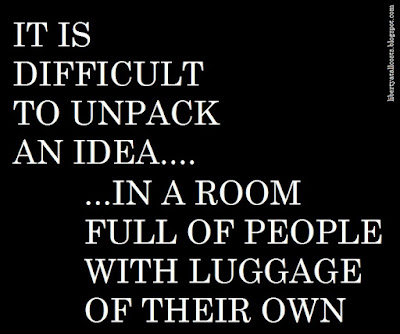
This just came to me today, but someone else might have come up with it already. Enjoy....
Thursday, May 19, 2016
That Good Story
In a conversation I am having at File 770, I was asked to define what makes a science fiction/fantasy book "great" for me. Rather than losing these radiant pearls of wisdom to the effluence of teh intertoobery, I thought I would cement them here in my personal record.
As this is the season of Hugo 2016, there will be some references to the current finalists for Best Novel as well as others from the recent past.
[In looking at my examples, it might appear that I am unfairly focused on N.K. Jemisin's work. I am not.
I just finished her book "The Fifth Season" as part of my reading for the Hugo awards and thus it is simply the most current example with which people may be familiar. I enjoyed that book a great deal. I'm glad that I bought it. I wish her every success in the future. She has some work to do before her work should be considered the best of the best, IMHO. added afterwards - ed.]
You may find the following links to other blog entries to be useful as well.
I Have Already Read Something Better
Naming the Names (books that were not as good as those in the first link, IMHO)
I know that the following is numbered. Don't think of them as being particularly prioritized in that order.
1. It Works For Me
Every book has a certain un-quantifiable factor, a je ne sais quoi if you will permit, that engages the reader in a unique, ethereal bond of the soul. What moves me at my deepest core (or in the case of MilSF, my corps) may not be nearly as impressive for another individual.
Another person who does not enjoy a of similarly satisfying experience with a given book is not defective. They might well be defective, but that difference of opinion about a book isn't enough to define the defect. The same works in the other direction as well, or at least it should.
But that isn't really very definitive, so perhaps we should look at factors that are more je sais quoi instead.
2. Take Me Some Place New
We have all ready books about elves and dwarves and tentacled gods from other dimensions and interstellar navies and armored soldiers. There are a couple thousand new books in the genre being published each year. Coming up with something genuinely new is pretty hard. So make it a new twist on an old trope. Or use a different configuration of old tropes. Just do not follow the herd.
Just imagine how many fewer sparkly vampire novels we would have if more writers followed that sage advice.
3. Focus On Interesting Characters
I'm not terribly interested in what characters look like. Get them dressed/undressed as the story demands and we can move on. What is interesting are the motivations and actions of those characters as they unfold in the story.
This is where "The Goblin Emperor" fell down just a bit for me. There was an awful lot of focus jewelry and other adornments thathad did not do much for me in terms of character/plot development. Some of that activity was certainly required to tell the story, but at some point it detracted from my experience with the book.
4. Value Humanity/Value The Individual
This is where I think Robert Heinlein shined. He put the focus on valuing the individual rather than talking about groups.
N.K. Jemisin's "The Fifth Season" was a very enjoyable read. But I have already read something better....link above. One area where her bookfeel fell short for me was the emphasis on class/caste structures. Very few had problems with class/caste structures existing. The ones we followed had more of a problem with the way those structures were being administered.
There was also a minor theme where the refugees/pirates had some sort of communal lifestyle where all cooking was done daily by one smaller group for the larger group. They were detailed (in a manner akin to a command economy) to that task. Child care was also communal. And I mention "pirates" as that is precisely what they were; remorselessly stealing the wealth produced by others.
"Socialism" is truly the economic system of fantasy writing as fantasy literature is the only place where it can produce desirable results. When socialism stops being evil in reality, then I'll adopt a different attitude towards socialism in fiction.
4. Be Tied To Reality In Some Way
SF/F stretches the boundaries of human conception for the purpose of giving us new ways of thinking about old issues. That is a property that makes the genre so influential and satisfying. However, there should always be some useful connection between the fictional characters/story and real human interactions.
Jim Butcher's "The Aeronaut's Windlass" did a very credible job of using the unusual circumstances of his imagined world to talk about a bit about race/class issues. He did so in a way that didn't beat the reader over the head. He was also able to create feelings of empathy for both of the military groups present within the story. At the very least, you could understand/appreciate some of the motivations of the "bad guys" group even if you disagreed with the actions they ended up taking.
Naomi Novik's "Uprooted" accomplished much the same thing towards the end when you got a chance to examine the experiences of the "evil" forest from their perspective.
5. Show A Sense Of Humor...or Humour
Give me a reason to smile. Even in the grim darkiest of the grim dark sub-genre there are examples of humor used to help lighten the mood. Humor also serves to provide a contrast that highlights the more serious events experienced by the characters.
Joe Ambercrombie's "The First Law" trilogy contains characters that use a fair amount of humor....typically gallows humor....to help them get through the challenges in their lives. Sebastien de Castell's deft use of humor in his "Greatcoats" series provides such a tremendous contrast that his books had me in tears over the breaking of his characters.
Real....live....man....tears.
N.K. Jemisin's "The Fifth Season" lacked an appreciable amount of humor and as a result my experience suffered.
6. Show Don't Tell
SF/F works traditionally involve a fair amount of info dumping. Topics ranging from orbital mechanics to computer based intelligence to sword play to the function of gemstones as a power source are generally beyond the daily experience of the average reader. So the author has to draw the reader into their fictional world by describing what makes that world work.
One way of describing that fictional world is to dump pages and pages of dry dissertation, treatise, and exposition on the reader. Erg.
Another method is to have one of the characters experience the limitations of the fictional world as a way of giving the reader a window into those limitations.
I have generally shied away from the steampunk genre precisely because they involve a fair amount of info dumping. That process has generally been along the lines of "Look! Gemstones! Chemicals! Miraculous hand-waving! Stuff happens!" Given how well I can suspend disbelief for tales involving magic, you would think that I could get past that sort of hand-waving. Alas no. So I haven't delved deeply into that sub-genre.
This year's Hugo nominee, "The Aeronaut's Windlass" by Jim Butcher, involves some heavy steampunk elements. But he limited the info dumping and had most of it occur in conjunction with events experienced by his characters. He did a good job of making his steampunk elements seem credible and translating them to the reader in a convincing manner.
Another Hugo nominee that has thus far (I'm still reading it) done a credible job with info dumping is Neal Stephenson's "Seveneves".
In comparison with those two novels, Ms. Jemisin's "The Fifth Season" made greater use of the dry expository passage approach.
7. Stay Away From Check Boxes
Whoo boy. I can smell trouble burning at the other end of the wire already.
"Check box" fiction really undermines the quality of my reading experience. What is "check box" fiction? It is a story that includes elements indicating diversity in the cast of characters that has zero impact on the the story.
In a reverse of the above, I'd like to suggest N.K. Jemisin's "The Fifth Season" as a good example of not doing "check box" fiction. One cluster of protagonists included a character that is straight, one that is seemingly bi-sexual, and one that is decidedly homosexual. They have a three-way.
And while the more patently descriptive passages of those events didn't do much for me, the fact that their respective sexuality helped inform their motivations and moved the story forward made the effort in describing their sexuality worthwhile reading. She also did a reasonable job at expressing how physical appearances differed based on regionalism. [There were one or two other moments that could be considered "check box(es)", but for the most part it wasn't a factor in this book.]
IMHO, including a character that is "different" without having that difference impact the story is at the very least a waste of time that detracts from the story and at the very worst insultingly dismissive of the people that possess the samecharacters characteristics.
Unfortunately, there has been a developing trend where authors appear to think that including such elements is the same thing as quality story-telling. Water is still wet. People still exist in a multiplicity of skin tones and gender identities. Ifthey the story takes place in the desert, then we should probably be focused on something other than how wet water can be.
And yes, I realize that the absence of water spoils the analogy. Work with me on this.
8. Tell A Good Story
That heading seems about as nebulous as the first one, no? But it isn't.
A lot of writers have "big ideas" about "meaningful stories". Which is fine.
Don't let those big ideas get in the way of good story-telling. Given the option of reading an engaging story without deep meaning or an OK story with deep meaning, I'd rather read the engaging story.
The Dragonlance series written/shepherded by Margaret Weis and Tracy Hickman includes good examples of good story-telling. Some of those stories had some sub-textual themes. Mostly they were just entertaining.
And I loved almost every book from that fictional world that I read. In fact I would take "Dragons of Winter Night" and/or "Dragons of Spring Dawning" over Orson Scott Card's "Ender's Game" precisely because they are better told stories. (I haven't read all of the books from the Dragonlance 'verse, but of those that I did read, the stinkers were few and far between.)
Tell a good story. Make the characters interesting. Make the factors of their personality matter to the story. Let the characters experience the world instead of dropping endless pages of exposition. Don't add characterizations if those characterizations do not have an impact on the story arc. Have a sense of humor. Place a high value on individuals. Have a tie to reality so that the story is relevant outside of itself.
Do this and I will enjoy your book. Do it not and I probably will not.
Pardon me whilst I don my asbestos Underoos.....
As this is the season of Hugo 2016, there will be some references to the current finalists for Best Novel as well as others from the recent past.
[In looking at my examples, it might appear that I am unfairly focused on N.K. Jemisin's work. I am not.
I just finished her book "The Fifth Season" as part of my reading for the Hugo awards and thus it is simply the most current example with which people may be familiar. I enjoyed that book a great deal. I'm glad that I bought it. I wish her every success in the future. She has some work to do before her work should be considered the best of the best, IMHO. added afterwards - ed.]
You may find the following links to other blog entries to be useful as well.
I Have Already Read Something Better
Naming the Names (books that were not as good as those in the first link, IMHO)
I know that the following is numbered. Don't think of them as being particularly prioritized in that order.
1. It Works For Me
Every book has a certain un-quantifiable factor, a je ne sais quoi if you will permit, that engages the reader in a unique, ethereal bond of the soul. What moves me at my deepest core (or in the case of MilSF, my corps) may not be nearly as impressive for another individual.
Another person who does not enjoy a of similarly satisfying experience with a given book is not defective. They might well be defective, but that difference of opinion about a book isn't enough to define the defect. The same works in the other direction as well, or at least it should.
But that isn't really very definitive, so perhaps we should look at factors that are more je sais quoi instead.
2. Take Me Some Place New
We have all ready books about elves and dwarves and tentacled gods from other dimensions and interstellar navies and armored soldiers. There are a couple thousand new books in the genre being published each year. Coming up with something genuinely new is pretty hard. So make it a new twist on an old trope. Or use a different configuration of old tropes. Just do not follow the herd.
Just imagine how many fewer sparkly vampire novels we would have if more writers followed that sage advice.
3. Focus On Interesting Characters
I'm not terribly interested in what characters look like. Get them dressed/undressed as the story demands and we can move on. What is interesting are the motivations and actions of those characters as they unfold in the story.
This is where "The Goblin Emperor" fell down just a bit for me. There was an awful lot of focus jewelry and other adornments that
4. Value Humanity/Value The Individual
This is where I think Robert Heinlein shined. He put the focus on valuing the individual rather than talking about groups.
N.K. Jemisin's "The Fifth Season" was a very enjoyable read. But I have already read something better....link above. One area where her book
There was also a minor theme where the refugees/pirates had some sort of communal lifestyle where all cooking was done daily by one smaller group for the larger group. They were detailed (in a manner akin to a command economy) to that task. Child care was also communal. And I mention "pirates" as that is precisely what they were; remorselessly stealing the wealth produced by others.
"Socialism" is truly the economic system of fantasy writing as fantasy literature is the only place where it can produce desirable results. When socialism stops being evil in reality, then I'll adopt a different attitude towards socialism in fiction.
4. Be Tied To Reality In Some Way
SF/F stretches the boundaries of human conception for the purpose of giving us new ways of thinking about old issues. That is a property that makes the genre so influential and satisfying. However, there should always be some useful connection between the fictional characters/story and real human interactions.
Jim Butcher's "The Aeronaut's Windlass" did a very credible job of using the unusual circumstances of his imagined world to talk about a bit about race/class issues. He did so in a way that didn't beat the reader over the head. He was also able to create feelings of empathy for both of the military groups present within the story. At the very least, you could understand/appreciate some of the motivations of the "bad guys" group even if you disagreed with the actions they ended up taking.
Naomi Novik's "Uprooted" accomplished much the same thing towards the end when you got a chance to examine the experiences of the "evil" forest from their perspective.
5. Show A Sense Of Humor...or Humour
Give me a reason to smile. Even in the grim darkiest of the grim dark sub-genre there are examples of humor used to help lighten the mood. Humor also serves to provide a contrast that highlights the more serious events experienced by the characters.
Joe Ambercrombie's "The First Law" trilogy contains characters that use a fair amount of humor....typically gallows humor....to help them get through the challenges in their lives. Sebastien de Castell's deft use of humor in his "Greatcoats" series provides such a tremendous contrast that his books had me in tears over the breaking of his characters.
Real....live....man....tears.
N.K. Jemisin's "The Fifth Season" lacked an appreciable amount of humor and as a result my experience suffered.
6. Show Don't Tell
SF/F works traditionally involve a fair amount of info dumping. Topics ranging from orbital mechanics to computer based intelligence to sword play to the function of gemstones as a power source are generally beyond the daily experience of the average reader. So the author has to draw the reader into their fictional world by describing what makes that world work.
One way of describing that fictional world is to dump pages and pages of dry dissertation, treatise, and exposition on the reader. Erg.
Another method is to have one of the characters experience the limitations of the fictional world as a way of giving the reader a window into those limitations.
I have generally shied away from the steampunk genre precisely because they involve a fair amount of info dumping. That process has generally been along the lines of "Look! Gemstones! Chemicals! Miraculous hand-waving! Stuff happens!" Given how well I can suspend disbelief for tales involving magic, you would think that I could get past that sort of hand-waving. Alas no. So I haven't delved deeply into that sub-genre.
This year's Hugo nominee, "The Aeronaut's Windlass" by Jim Butcher, involves some heavy steampunk elements. But he limited the info dumping and had most of it occur in conjunction with events experienced by his characters. He did a good job of making his steampunk elements seem credible and translating them to the reader in a convincing manner.
Another Hugo nominee that has thus far (I'm still reading it) done a credible job with info dumping is Neal Stephenson's "Seveneves".
In comparison with those two novels, Ms. Jemisin's "The Fifth Season" made greater use of the dry expository passage approach.
7. Stay Away From Check Boxes
Whoo boy. I can smell trouble burning at the other end of the wire already.
"Check box" fiction really undermines the quality of my reading experience. What is "check box" fiction? It is a story that includes elements indicating diversity in the cast of characters that has zero impact on the the story.
In a reverse of the above, I'd like to suggest N.K. Jemisin's "The Fifth Season" as a good example of not doing "check box" fiction. One cluster of protagonists included a character that is straight, one that is seemingly bi-sexual, and one that is decidedly homosexual. They have a three-way.
And while the more patently descriptive passages of those events didn't do much for me, the fact that their respective sexuality helped inform their motivations and moved the story forward made the effort in describing their sexuality worthwhile reading. She also did a reasonable job at expressing how physical appearances differed based on regionalism. [There were one or two other moments that could be considered "check box(es)", but for the most part it wasn't a factor in this book.]
IMHO, including a character that is "different" without having that difference impact the story is at the very least a waste of time that detracts from the story and at the very worst insultingly dismissive of the people that possess the same
Unfortunately, there has been a developing trend where authors appear to think that including such elements is the same thing as quality story-telling. Water is still wet. People still exist in a multiplicity of skin tones and gender identities. If
And yes, I realize that the absence of water spoils the analogy. Work with me on this.
8. Tell A Good Story
That heading seems about as nebulous as the first one, no? But it isn't.
A lot of writers have "big ideas" about "meaningful stories". Which is fine.
Don't let those big ideas get in the way of good story-telling. Given the option of reading an engaging story without deep meaning or an OK story with deep meaning, I'd rather read the engaging story.
The Dragonlance series written/shepherded by Margaret Weis and Tracy Hickman includes good examples of good story-telling. Some of those stories had some sub-textual themes. Mostly they were just entertaining.
And I loved almost every book from that fictional world that I read. In fact I would take "Dragons of Winter Night" and/or "Dragons of Spring Dawning" over Orson Scott Card's "Ender's Game" precisely because they are better told stories. (I haven't read all of the books from the Dragonlance 'verse, but of those that I did read, the stinkers were few and far between.)
Tell a good story. Make the characters interesting. Make the factors of their personality matter to the story. Let the characters experience the world instead of dropping endless pages of exposition. Don't add characterizations if those characterizations do not have an impact on the story arc. Have a sense of humor. Place a high value on individuals. Have a tie to reality so that the story is relevant outside of itself.
Do this and I will enjoy your book. Do it not and I probably will not.
Pardon me whilst I don my asbestos Underoos.....
Wednesday, May 11, 2016
Naming The Names
As I have become more focused on reading for the Hugo Awards, I have spent quite a bit of time looking over some recent nominees. I have pointed out that I have read other works that I found to be better reading experiences in comparison with recent nominees. What I have not done is pointed out those nominees that I found to be less than stellar.
A note just in case. I have enjoyed reading all of these books. I am proud to own at least a signed copy of at least one of these books. I am glad that all of these authors are experiencing different levels of success.
I just do not happen to think that these are one of the five best SFF novels produced in their respective years. I have read something better.
I can't comment on the rest of the nominees as I haven't given them a full reading.
[1] By John's own admission, The Last Colony was missing something. Which is how Zoe's Tale came into being. Two halves of a good book are not independently worthy of being a top 5 book, IMHO.
[2] This was the winner in 2000! I enjoyed it, but didn't think it was that great. Curiously, I did like A Fire Upon the Deep by Mr. Vinge a great deal and can see why it won in 1993. The two books are related.
[3] Added on 5/16/2016. I just finished it over the weekend. While it was a very good book, I have, indeed, read better books.
[4] This entire series just seems like an identity journey with some science-fictionium and fantasium slathered on. The artwork isn't terribly interesting. I've never seen the attraction of reading it and can think of several other series that I'd rather read. And yet it will get nominated in almost every year. I enjoy the author's work in other series immensely. This one? Leave it.
A note just in case. I have enjoyed reading all of these books. I am proud to own at least a signed copy of at least one of these books. I am glad that all of these authors are experiencing different levels of success.
I just do not happen to think that these are one of the five best SFF novels produced in their respective years. I have read something better.
- 2016 - The Fifth Season by N.K. Jemisin[3]
- 2015 - The Goblin Emperor by Katherine Addison
- 2012 - A Dance with Dragons by George R.R. Martin
- 2011 - The Hundred Thousand Kingdoms by N.K. Jemisin
- 2009 - Zoe's Tale by John Scalzi[1]
- 2008 - The Last Colony by John Scalzi[1]
- 2000 - A Deepness in the Sky by Vernor Vinge[2]
- 2015, 2017, 2018 - Saga (graphic novels) by Brian K. Vaughan & Fiona Staples. [4]
I can't comment on the rest of the nominees as I haven't given them a full reading.
[1] By John's own admission, The Last Colony was missing something. Which is how Zoe's Tale came into being. Two halves of a good book are not independently worthy of being a top 5 book, IMHO.
[2] This was the winner in 2000! I enjoyed it, but didn't think it was that great. Curiously, I did like A Fire Upon the Deep by Mr. Vinge a great deal and can see why it won in 1993. The two books are related.
[3] Added on 5/16/2016. I just finished it over the weekend. While it was a very good book, I have, indeed, read better books.
[4] This entire series just seems like an identity journey with some science-fictionium and fantasium slathered on. The artwork isn't terribly interesting. I've never seen the attraction of reading it and can think of several other series that I'd rather read. And yet it will get nominated in almost every year. I enjoy the author's work in other series immensely. This one? Leave it.
Subscribe to:
Posts (Atom)