Wednesday, May 12, 2021

Filtration Or Net Fishing For Fiction

Alternatively...The Windmill is My God and Cervantes is the Most Holy Prophet.  Lord make me a fisher of books!

Take your pick.

In my series of continuing digressions into fandom, I'd like to add some (hopefully apolitical) thoughts about how readers find books.  I'm not sure if filters or nets are the better analogy.

Filters capture contaminants but allow useful material to flow past.  Contaminants are usually a small percentage of the whole.

Fishing nets capture the relatively smaller volume of desired material (i.e. fish) while letting the vast majority of material (i.e. water) flow through.  The size of the net can influence what you "catch".  Small, tight nets with smaller gaps are tossed off of docks and from the shore to catch small baitfish.  Larger nets with larger gaps are floated in the oceans (or really big lakes) to catch tuna and other larger fish.

Maybe nets are the better analogy.

Not only does the size of the net matter, where you use it matters.  Using a small net in the middle of the ocean probably won't yield as many baitfish compared with tossing it off of a dock.  Using a drift net in the middle of a small river might yield a few large carp, a turtle or two, and maybe some bass, but you won't catch bucketloads of smelt.  Using a net off of the coast of California coast will yield a different catch than the same net in the Caribbean or in the Aral Sea.  [yes...I know...that's the point]

So what are the "nets" of fandom?

I Like That Author's Prior Work - This is an easy one.  An author writes a really good book that deeply affects the reader.  That reader is more likely to make time for any subsequent work from that author thereby precluding the time needed to "cast a net in a different spot".

The [insert publisher here] Mailing List - The Tor mailing list, to name one.  I'm on it.  Periodically they offer a free book that sounds interesting.  Free and interesting fiction is an easy way to attract reader attention.  

Professional Reviews - Sites such as Locus Magazine and Bookbub do a pretty good job of identifying quality fiction.  However, they do not read and review everything.  All professional review sites include internal processes that limit the span of their reviews.

Acquaintances and Friends - Word of mouth is a good means of spreading the news about an author and/or their work.  The only qualifier is that one's range of acquaintances needs to be sufficiently broad to encourage exposure to a diverse range of authors and works.  As much as I enjoyed books out of the Dragonlance mythos, I would not trust a group of friends who focus on reading Dragonlance books to tell me about the best works in the wider science fiction/fantasy genre.

Contests/Awards - Whether juried or based on reader voting, awards can be a great way to find new authors and works.  Currently, my best award-based experiences are with the Self Published Fantasy Blog Off.  I have good experiences with some other contests as well, but this one has provided me with the best results.

Other? - I think the above pretty well covers most of the major "nets".  But who knows.

Why is this important?  Take a look at this year's best novel nominees for the Hugo Awards.

  • Black Sun, Rebecca Roanhorse (Gallery / Saga Press)
  • The City We Became, N.K. Jemisin (Orbit)
  • Harrow the Ninth, Tamsyn Muir (Tor.com)
  • Network Effect, Martha Wells (Tor.com)
  • Piranesi, Susanna Clarke (Bloomsbury)
  • The Relentless Moon, Mary Robinette Kowal (Tor Books)
I had heard about five of those six books as they were released last year.  I had not heard about Piranesi.  Ironically, that is one of only two books that I am looking forward to reading.  

I read Network Effect because I was plowing through the rest of the Murderbot series at the time.  I was interested in Harrow the Ninth because I thought the prior entry in the series, Gideon the Ninth, was quite good.  I didn't read Harrow last year because I was predicting that it would be a finalist this year.

I didn't bother with reading the rest of those books for the same reason; the relatively small, and quite frankly provincial, group of people nominating works for the Hugo Awards appear to have a rather limited range of "nets" for finding good new books.  They also seem to have a limited number of "fishing spots" in which to ply those "nets".

The lack of diversity among the nominees suggests to me that the group of nominators lacks diversity in their reading habits and expectations.  The quality of the awards will suffer until that changes.

Wednesday, May 5, 2021

Yet Another Government Action Undermining Our Republic

There is an article over at Rasmussen discussing the 2020 census and the "updates" that have been applied by the Biden Administration.  While this is written as an opinion piece, it is being hosted over at Rasmussen; a serious polling firm that tries to do polling correctly and accurately.

The Biden Administration has inexplicably "adjusted" the population counts for several Democrat-leaning states.   The obvious result is that those states will not lose as many seats in the US House of Representatives.  The flip side of that is that there are Republican-leaning states that will not gain as many seats in the US House.

My many friends on the left that wonder why I distrust their version of expansionist government should refer back to this issue in the coming years.

There is an extensive and well-documented trend of people moving out of Democrat-leaning states and into Republican-leaning states.  Adjusting the census values to minimize that trend is questionable.  The fact that all of the adjustments run in one political direction is also questionable.

Highly questionable.

While I am not a big fan of "deep state" conspiracy theories, I do think there are cultural issues in play.  The civilian employees have a preference in terms of their working conditions and the operations of their respective agencies.  Generally, the larger the agencies, the better the employee's chances for advancement and the less their chance of being laid off.

People living in majority Democrat places tend to expect more government services and support the politicians that advocate for funding those services.  

There is a bit of symbiosis between Democrat politicians and government employees.  This isn't a purposeful conspiracy but rather is just the natural alignment of groups with objectives that complement one another.

Here's the problem.  If Donald Trump had won the 2020 election and had his administration "adjusted" the census count to enhance Republican representation in the US House without sufficient justification, then wouldn't the Democrats have screamed bloody murder?  Impeachment?  Hell, they would have howled even if the justifications were documented and reasonable.

The mainstream media, ever a leftist-friendly group, would have come unglued.  Allegations of vote fixing would be broadcast 24 hours per day.  It would have been presented as an abridgement of the voting rights of the citizens of those Democrat-leaning states.  Other speculation would have been offered with wild abandon.

I predict that none of these people will have any issue with the Biden Administration's attempt to manipulate the census for political objectives.  I also predict that they will look at anyone that questions these "adjustments" as if they had grown a third eye in a prominent location.

The lack of a critical media response is just the latest example of how our demonstrably biased media is undermining our great Republic.

The following are from the article.  Read the whole things for additional context.

No. 1: New York -- We've been tracking the annual population/migration changes between states since the last census in 2010. Over the past decade, New York LOST about 1.3 million residents on net to other states. (This does not include immigration, births and deaths.) Still, this is a population loss that is the equivalent of two, maybe three, lost congressional seats. But the final numbers ADDED approximately 860,000. That's roughly twice the population of Buffalo and Rochester -- combined. This is the state that has lost by far the largest population over the past decade.

No. 2: Many deep-blue states had 2020 census numbers significantly revised upward from their December estimates: Connecticut, Hawaii, Illinois, Massachusetts, New Jersey, New York, Rhode Island and Vermont.

No. 3: Many red states had 2020 census numbers lower than their 2020 estimates: Arizona, North Carolina and South Carolina.

No. 4: Going back to the 2010 Census, the final head count in every state was within 0.4% of the original estimate, and 30 of them were within 0.2%. This time around, 19 states were more than 1% off, 7 were more than 2% off, NY was more than 3.8% off, and NJ was more than 4.5% off.

No. 5: Virtually every one of the large deviations from the estimates favored Democrats. Just five states in the 2020 census were within the same margin (0.41%) that all states were within from the 2010 census.

Sunday, April 25, 2021

Media Bias - A Rumination On Ruination

 Media bias is real.  It has been measured in the past and it continues to be proven on a regular basis.  Project Veritas, in a tremendous bit of undercover reporting, got a CNN producer to admit that they had altered their news coverage to make Donald Trump look worse and Joe Biden look better.  Their intent was to alter the results of the 2020 Presidential election.  

It looks to me like they were successful.

A few weeks before that, CBS's 60 Minutes program offered some fake news as real news by attempting to paint Florida Governor Ron DeSantis as being in some way corrupt in his administration's deployment of the Covid vaccines.  60 Minutes lied.

What brings me to this topic today is how the illicit bias of our mainstream media is helping to undermine American civilization.

I watched it for years.  My dad would frequently go off on a rant about Donald Trump.  Sometimes he was right.  But more often than not he was basing his thoughts on his continual media diet of CNN along with occasional pieces from CBS, NBC, etc.  At no point did he encounter any media personality offering a dissenting opinion.

I'm not sure if it makes me sad or glad that dad wasn't around to find out that he was sold the fiction of the Trump/Russia allegations.

I am sad to see that it never ends.  The policies of New York Governor Andrew Cuomo undeniably resulted in tens of thousands of senior citizens dying due to Covid-19.  His administration lied about those deaths for months.  Yet the mainstream media lionizes Gov. Cuomo as being a marvelously successful governor.  Parenthetically, the administration of Michigan's Governor Gretchen Whitmer followed similar regulatory policies with reasonably similar results.

The same media portrays Ron DeSantis as being an absolute failure with respect to Covid-19.


The data tells a much different story.  As of February 15th, Florida's deaths due to Covid on a per capita basis were below the national average.  At the very least, in the middle of the pack.  Michigan ranked a bit higher.  A bunch of northeastern, high-density states had the worst outcomes.

But this isn't the story that you get from our mainstream media.  Instead, we get a highly distorted narrative where reporters commit verbal contortionism to create the impression that Democrat governors have all the correct policies while Republican governors have all the wrong policies.  So-called "red" states are presented as if people are dying in the streets.

The truth is more complex and a bit nuanced.  It is also true that attempting to fit any reporting on Covid into a strictly "Democrat vs. Republican" narrative is impossible if the media is committed to reporting the facts.  Some Democrats had good policies and some had bad ones.  The same is true for Republicans. 

If they are instead committed to acting as agents of propaganda, if they have taken a political side within the American culture, then the reporting of facts is no longer of concern.

And the ruination of American civilization lies dead ahead like the iceberg waiting on the Titanic.

Friday, April 23, 2021

2016 Hugos - Novel

I found the following while looking through my unpublished blog entries.  Most of this written back in 2016 with the exception of the last two novels on the list.

---------------------

I didn't get around to the novel category last year.  I focused on the sub-novel length works last year and ran out of time.

My mistake.

This year, I started buying the novel nominees as soon as the finalists were announced.  I didn't wait for the packet as I really wanted to get through as much material as possible. 

My thinking on the finalists in this category has changed over time.  I finished the last one in late May or early June.  Since then, I have changed my vote a couple of times. 

This is not a full-on book review.  It's just my impressions relative to my voting for the Hugos.  Without further delay, here we go.

Spoilers!!.....duh

The Cinder Spires: The Aeronaut's Windlass by Jim Butcher (Roc)

While this book was not my first read, it was by far my favorite.  The novel includes multiple character perspectives and very detailed fantasy world-building.  

I thoroughly enjoyed the positive themes of people governing themselves politically and individually.  There was a tension between the idealized version of how people viewed themselves and the reality of how they interacted with the world around them.  There was a sub-text of people aspiring to be better than they were.

That goes for many of the antagonists as well.  One of the hallmarks of good writing is to create interest/sympathy for an antagonist.

In addition to creating a well-formed and coherent world filled with a variety of character types, he has also accomplished the unique task of making a steampunk-themed world sensible to me as well as making me like cats.

The Fifth Season by N.K. Jemisin (Orbit)

Reflection on this novel has resulted in the most significant change to my ballot.  It has moved twice from fourth to second place.  In terms of world development and plotting, I find it to be a very narrow second to The Cinder Spires.

Ms. Jemisin has created a wonderfully detailed world.  The one regrettable feature is the unquestioned class/career social structure that affords few opportunities for individuals to follow a unique path.

Four issues separate this novel from being in first place.

The acceptance of socially imposed class/career structures.  The protagonists don't really mind being limited to what they are as long as they aren't on the bottom of the social structure.  They don't advocate for equal liberty.  They advocate for some other caste to be on the bottom of the pile.

The idealization of society as a sort of quasi-socialist utopia.  For a brief time our protagonists are free from their masters and join a quasi-socialist society run/led by people of their "caste".  The society indulges in common cooking arrangements rather than household/individual sufficiency.  The society survives by stealing the productive wealth of others instead of producing something of use that can be traded.

(Socialism appears to be the currently preferred political system of fantasy writing.  Which is appropriate as the only place where it works is as a fantasy.  In the real world it is the most bloody and oppressive system invented by humankind.)

The primary characters are self-absorbed with their social position without a sense of humor.  They are almost wholly consumed with achieving revenge.  No matter how justified their revenge might be...and it is justified...I just am not interested in reading about characters that do not aspire to be something better.  Ms. Jemison might take a look at Joe Ambercrombie's First Law series to see characters with both nasty and humorous sides that want to be something better tomorrow than they are today.

The book centers on the plight of the social cast of orogenes;  people that can manipulate the earth.  Among other skills, they can create or silence earthquakes; quite useful on a planet that is quite seismically active.  The orogenes are kept under control (effectively held as slaves) by another caste.  There is precisely one orogene in the book that is free to do as he pleases.  I find the lack of refugee bands of orogenes to be less than believable.  Of course, groups of free orogenes running around would result in a very different book.

In thinking about the sub-text of the world, consider the orogenes as government power instead of as individuals.  From that perspective, the novel suggests that their unrestrained power is in some way a good thing.  Human experience suggests that unlimited government power generally results in poverty and oppression.  But that is not a sub-text that the author intends.  I think that subtle shift would have made this a better novel.

Uprooted by Naomi Novik (Del Rey)

I loved Uprooted from the start.  This is a tale about a young woman living in a land where a wizard comes every few years to take a young maid to his castle.  The maid is always returned safe and sound to her family, but after the experience is rarely satisfied with her small-town life thereafter.

The wizard usually takes the most beautiful young maid.  But one year, he takes the one who appears to have some innate ability to learn/use magic in lieu of greater physical beauty.

The story unfolds along the intersection of two themes.  One theme is the conflict between good and evil.  Evil is represented by an unknown malignancy that grows in a specific forest.  The forest seeks to spread itself and thereby spread the evil.

The second theme is that of magic that is traditionally learned as more of rigorous science with formal rules and traditions as to how magic is performed.  As a contrast, our young heroine slowly blossoms into a sort of magic performed by intuition and feelings instead of as the result of rules and study.

The novel begins at a modest pace that unfolds the world in an interesting manner.  The pace rapidly accelerates as the "evil" spreads and the wizard must respond to ever-increasing threats.  The storyline unfolds in a reasonably linear format that primarily follows the one central character.  The linear format is not as complex as the multiple threads used in the two preceding works.

The weakest part of the story is the last few chapters where we learn that the "evil" is simply misunderstood and the "good" isn't as good as they think.  The "healing" comes from the new wizard, our young, intuitive heroine, who slowly repairs centuries of harm with intuition and empathy.

I was less than impressed with the ever flawed concept of being able to feel our way to new solutions to old problems.

I loved the writing, the use of language, and the general story.  The subtext was less than inspiring.  That subtext coupled with the generally more simple/linear framework put this book in third place on my ballot.

Seveneves: A Novel by Neal Stephenson (William Morrow)

Seveneves is two novels in one.  The first half presents a global catastrophe in the form of the destruction of the moon.  The resulting detritus rains down on the earth, raising the atmospheric temperature, and generally making the planet uninhabitable.  Humanity races for lifeboat rockets that will allow a limited number to survive until the planet cools.

Hijinx ensue.  People cheat the system designed to preserve the most genetically/biologically fit individuals.  There are daring rescues and grisly conflicts.  The close of the first half brings us to what is left of the moon still in the usual orbit.

Seven women are the sole survivors among the thousands of humans that left the planet.  Fortunately, one of them is a highly skilled geneticist who can create sufficient genetic diversity to allow humanity to survive this rather extreme genetic bottleneck.

The second half begins by leaping a few thousand years in the future.  Humanity has built a myriad of space-born structures.  The population has expanded and split into seven discrete groups based on their progenitors.  Each group reflects inheritable qualities from each of those seven women.  There is some interbreeding between the groups, but not all that much.

All of the cultural norms from thousands of years of human civilization are gone.

The earth has cooled and humanity is ready to come home.  Exploration has begun.  It turns out that the humans that left the planet are not the only ones to have survived.  There is conflict and confrontation between all of the descendants of humanity.

While I enjoyed this book a great deal, there were a couple of issues.  The first is the behavior of the seven surviving women.  They meet in the immediate aftermath of a conflict that results in the death of every other human.  They immediately sit down for a conference on how they can survive.  One of the first topics is the lack of genetic diversity.

The geneticist indicates that she can manipulate genetic codes to create the diversity that will be needed to help the human race survive.  What is ignored is the comparative treasure trove of genetic material present in the bodies that are floating all around them.  Instead of sitting down to have a chat, they could have immediately improved their genetic diversity by collecting and freezing samples.

The second issue is the range of "technology" that develops in the centuries that follow.  Some of it is impressive and seemingly possible.  Some of it represents flights of fancy.  Books that attempt to be hard science fiction should avoid flights of fancy.

One such flight is pretty significant.  There is a structure that is a spinning ring that orbits the earth.  Other human settlements/structures pass through the middle of this ring as it swings around the earth.  The big problem here is that the axis of motion for the spinning ring would be roughly parallel to the equator.  This would result in the precession of the axis; the ring would rotate as it orbited the earth.  There would be too many times when this precession would preclude any other object from passing through the middle of the spinning ring.  

There were other flights of fancy in the back half of the book that had my "nit-picking reader" fully operational.  There was so little of that sort of thing in the first half of the book that it was a bit confounding to find so much of it in the back half.

I very much enjoyed the book and understand why others would nominate it.  But it wasn't as good as the other works listed above.

No Award

Ancillary Mercy by Ann Leckie (Orbit)

This is being written in 2021.  A few years have passed.  This novel bounced off of me pretty hard for a couple of reasons.

One of those is the plot point that the controlling political forces don't care about gender.  Humans care about gender even if there are alien species that do not.  I am moved by books about humans and human reactions.

Another is that this is a putatively MilSF novel in which our intrepid military protagonist response to every point of conflict by sitting down to a nice cup of tea.

Those issues aside, this was a reasonably interesting if not terribly memorable novel.  It just didn't clear the bar relative to the Hugo Awards for me.

Book Review - The Stone Knife


The Stone Knife (The Songs of the Drowned, #1)The Stone Knife by Anna Stephens
My rating: 1 of 5 stars

Cardboard characters. The introductory chapters felt more like an identity politics indoctrination class rather than a work of fiction where individual identities are an integral part of the narrative.

Dorothy Parker is holding on line 1.

View all my reviews

Tuesday, April 20, 2021

420 Is An Odd Number

You might not know it, but April 20th is a pretty great day.  April 20th is "National Lookalike Day".  A great day for identical twins and regular folks that just happen to look a little too much like someone else for comfort.

Numerically, 4/20 is a day that is high on many people's calendars.  Sometimes you have to weed out the stems and leave the useless stuff aside, but eventually, something great will flower on a day like today.

For those with a powerful case of the munchies, today also happens to be National Cheddar Fries Day and National Pineapple Upside-Down Cake Day.  Munch on!

Appropriately enough, this is National Volunteer Recognition Day.  Remember to give thanks to those that volunteer to make your community a better place.  If you don't get thanked, then consider volunteering.  There are some great organizations out there that would appreciate your time and effort.  For my fellow vets, I recommend the American Legion and Veterans of Foreign Wars.  Jarheads already know about the Marine Corps League.  Find a group and make your piece of the world better.

A lot of great stuff happened in history on April 20th.

Freedom of religion was granted to the Jews of New Amsterdam (later New York City) in 1657.  The Siege of Boston began following Concord and Lexington.  It was the hard beginning of a war that turned out pretty well for the Americans.

The US Congress created the Wisconsin Territory in 1836.  Where would we get great cheese if we didn't have Wisconsin?

Of course, there were some bad things that happened on April 20th as well.  The Columbine High School massacre happened on this day.  

Adolph Hitler was born on this day.  But I choose to remember that today was also the last time that dirty paper hanger saw the sun, 1945.  It was the last time he left his bunker before he took the coward's road.

April 20th was the last day of the Bay of Pigs invasion.  Sadly, Fidel and his communist cronies survived to oppress the Cuban people.

Today happens to be the 49th anniversary of the Apollo 16 landing on the moon in 1972.  Ken Mattingly famously missed out on the Apollo 13 flight and got rotated into the Apollo 16 slot.  He ended up doing an EVA on the return flight to the Earth to retrieve some external equipment.

Danica Patrick won the Indy Japan 300 in 2008 and became the first female driver to win an Indycar race.

Lots of interesting people died on April 20th; for example, Antipope Victor IV.  He was elected by a dissenting group of Cardinals to be a dissenting Pope in opposition to Alexander III.  The two vied for control of the church until Victor's death.  Alexander III reprimanded his Cardinals for celebrating Victor IV's death in 1164.  Victor IV's grave was destroyed by the order of Pope Gregory VIII when miracles were reported at the gravesite.  Can't have a dissenter be seen as doing anything productive, can we? [It turns out that Antipopes were a "thing" for quite some time!]

The Third Great Khan of the Mongol Empire, Güyük Khan, died on this date.  Chief Pontiac, proclaimed by some as the most famous Indian of the eighteenth century, was assassinated on April 20th.

Bram Stoker, of Dracula fame, died on this date in 1912.  Funnyman Benny Hill passed on this date in 1996.

Some interesting people came into the world on April 20th.

General Holland "Howlin' Mad" Smith developed the first amphibious landing techniques and became the "father" of modern American amphibious warfare.  For us Marines, the ability to go from water to land and back again is mighty important!  General Smith concluded his career as the Assistant Commandant of the Marine Corps.  He was born this day in 1882

John Paul Stevens started out on this date in 1920.  He eventually served as an Associate Justice on the U.S. Supreme Court.

George Takei, of Star Trek fame, was born on this day in 1937.  American author Peter S. Beagle joined the club in 1939 while actress Jessica Lange came aboard in 1949.  Luther Vandross was born this day in 1951.  We also have Killer Mike who came along in 1975.

Don Mattingly, the baseball player and manager, started out on April 20th in 1961.  Actors Crispin Glover and Andy Serkis (Gollum!  Smeagol!  Caesar!  Richard!) came along on this date in 1964 while Carmen Electra was born in 1972.

April 20th, 1965 also happens to be the birthday of Steve Rogers.  We were friends from the same little neighborhood and graduated together from the same high school.  We were even in Mrs. Allen's 5th-grade class together in 1976.  Steve died unexpectedly a few weeks back.  This has to be a pretty hard day for his family this year.

April 20th is my birthday as well.  We haven't had snowfall in Michigan this late in April for decades.  Y'all can blame it on me.


Update - It stuck on the ground!


And it has stuck through most of the following day.  Woohoo!!


Wednesday, April 14, 2021

Hugo Nominees 2021 - Preliminary Thoughts

The short-listed nominees for the 2021 Hugo Awards have been announced.  Like many, I have thoughts.

Best Novel -

  • Black Sun, Rebecca Roanhorse (Gallery / Saga Press / Solaris)
  • The City We Became, N.K. Jemisin (Orbit)
  • Harrow The Ninth, Tamsyn Muir (Tor.com)
  • Network Effect, Martha Wells (Tor.com)
  • Piranesi, Susanna Clarke (Bloomsbury)
  • The Relentless Moon, Mary Robinette Kowal (Tor Books / Solaris)

As I have suggested in the past, the nominators seem to be focused on a limited range of authors.  I purposely didn't read Harrow The Ninth or The City We Became in 2020 because I knew they would be on the short-list this year.  I did read Network Effect as I was working through the prior novella-length entries in that series already.  

The point is that four of the six nominees have had other works nominated recently.  Of the other two, Martha Wells' series is popular with many nominators.  I was unaware of Piranesi before it was nominated.  Upon reading the summary at Goodreads, I have high hopes for this book.  I can't say where it will appear on my ballot, but the concept sounds interesting to make it worth my time to read.

At least three of the works are subsequent entries in a series.  In my experience, subsequent entries in a series rarely surpass (much less equal) the quality of the first entry.  Very rarely.  If the initial entry didn't win, then I doubt subsequent entries will do any better.

I participate in the Hugo Awards to encounter new works and/or authors that I might have otherwise missed.  Having so many repeat nominees and/or serial entries diminishes that possibility.

Meryl Streep is the only actor that gets nominated for an Oscar for almost every movie she makes.  That's a bit odd, but it's Meryl.  Now we have a cadre of four authors that are repeatedly making the short-list?  Nope.

Best Novelette -

I nominated the novelette I Sexually Identify As A Helicopter by Isabel Fall.  I found it remarkable.  The con staff has shown the title as "Helicopter Story".  The original publisher, Clarkesworld, has indicated that the author changed the name at some point in time.  The author has indicated a willingness to accept the award.  It is Isabel's prerogative to rename the story.  While I will use the new title for participation in reading/reviewing/ranking the nominated works, I do wish that Isabel had kept the original name.  The only way to beat bullies is to never give them an inch of what they are asking.  Isabel was indeed bullied last year over this story.

Best Series - 

This is the first category where I would like to have a method for putting certain titles below "No Award" without harming the chances of the rest of the field.  I don't know that I will have time to sample all of the series.  While I have heard good things about a few of the nominees, I consider only one of the three series that I have sampled to be worth considering for the award in this category.

Best Related Work -

Best Dramatic Presentation, Long Form - 

There is at least one and perhaps two nominees in each of these categories that I would like to put below "No Award" without harming the chances of any of the rest of the nominees.  Alas, this is impossible.

Best Graphic Story -

  • DIE, Volume 2: Split the Party, written by Kieron Gillen and Stephanie Hans, letters by Clayton Cowles (Image Comics)
  • Ghost-Spider vol. 1: Dog Days Are Over, Author: Seanan McGuire, Artist: Takeshi Miyazawa and Rosie Kämpe (Marvel)
  • Invisible Kingdom, vol 2: Edge of Everything, Author: G. Willow Wilson, Artist: Christian Ward (Dark Horse Comics)
  • Monstress, vol. 5: Warchild, Author: Marjorie Liu, Artist: Sana Takeda (Image Comics)
  • Once & Future vol. 1: The King Is Undead, written by Kieron Gillen, iIllustrated by Dan Mora, colored by Tamra Bonvillain, lettered by Ed Dukeshire (BOOM! Studios)
  • Parable of the Sower: A Graphic Novel Adaptation, written by Octavia Butler, adapted by Damian Duffy, illustrated by John Jennings (Harry N. Abrams)

On a positive note, there isn't a Saga entry for this year.  On another positive note, I have been meaning to read DIE Volume 2.  On a negative note, Monstress is nominated for the fifth consecutive year.  I have thoroughly enjoyed Monstress.  I might even put Volume 5 in the first spot on my ballot.  But I am suspicious when consecutive works in a series always find their way onto the short-list over and over with only 303 people nominating in the category. 

Best Semiprozine - 

Escape Pod & PodCastle do not seem to be properly placed in this category.  They are both podcasts that are comparable to podcast nominees from prior years in the "fancasting" category that were also headlined by professional writers.  Fortunately, I probably will not get to this category.  If there was a means of placing those nominees below "No Award" without harming the chances of the rest of the nominees, then I would surely use it.

Best Fancast - 

While there are a couple repeat nominees, there are also several new titles.  I'm looking forward to sampling their work. [updated] I just couldn't do it.  There were too many repeats to want to wade through all of the entries to give them a fair sampling.

-----------------------

I wish entertaining times for everyone in the coming months.  If you haven't participated in the Hugo Awards in the past, then I recommend you give it a try.  You will encounter some of the best work being done in the genre.

Monday, April 12, 2021

"But The Book I Like Is Better!"

 I was engaged in an online discussion about the relative popularity of novels that were nominated for the best novel Hugo award.  This discussion was sometime last August (2020).  

The primary assertion being made last August was that Larry Correia's works aren't as popular as those selected for the Hugo best novel shortlist.  A couple of other conservative-leaning authors were included for comparison purposes by one interlocutor.  I am interested in not seeing authors excluded from critical evaluation based on their politics.  Also, I'm not a specific fan of Mr. Correia. His Saga of the Forgotten Warrior series is on my TBR pile.

These discussions frequently end in pointless goalpost shifting, confirmation bias, and very selective cherry-picking of data.  A book that sells a lot of copies will be called great as long as the right sales numbers can be used to buttress a person's perspective; "my book is so good that everyone read it".  Once sales volume information runs against their perspective, there will be a switch to how the book is underappreciated and better than some best-selling bit of popular drivel; "your sales numbers don't matter because popular drivel isn't as good as my obscure book".  Or two different sub-genre categories will be used to "prove" something.

Watching two people, or two groups of people, flip and flop over what defines a book as "great" was once entertaining, but now is just tiring.  Given the growth in the number of genre titles published each year, it is becoming easier and easier for a reader to find a quality piece of genre literature that has not come to their attention previously.

As an exercise, here were the books for the 2019 Hugo Best Novel award along with their rankings via Amazon.  These are overall Kindle rankings as I couldn't find a good method for limiting it to the SF/F genre.  The data was pulled on 4/7/2021.

#65,263 - The Calculating Stars, by Mary Robinette Kowal (Tor)

#144 - Spinning Silver, by Naomi Novik (Del Rey / Macmillan)

#15,771 - Record of a Spaceborn Few, by Becky Chambers (Hodder & Stoughton / Harper Voyager)

#38,356 - Trail of Lightning, by Rebecca Roanhorse (Saga)

#66,783 - Revenant Gun, by Yoon Ha Lee (Solaris)

#166,183 - Space Opera, by Catherynne M. Valente (Saga)


I was partial to Grey Sister by Mark Lawrence; also published in 2018.  It didn't even make the long list for the Hugo best novel category.  I would easily put it above at least half of the short-listed works.

#31,699 - Grey Sister - Mark Lawrence

[An aside.  I pulled data last August for those same books and got VERY different results.  The Calculating Stars was closer to the #10,000 to #15,000 range.  Spinning Silver wasn't nearly that high in Kindle sales as it was on 4/7/2021.

Perhaps Kindle rankings aren't a great comparison method as it shifts over time.

My original point was that Grey Sister was an equally popular book that was largely ignored by the pool of Hugo nominators.  I think the point is worthwhile even if the shifting sands of the Kindle ranking algorithm aren't of any utility in proving the point.

End aside.]

Simply focusing on a few, select conservative-leaning authors is a distraction from the larger point that there are a lot of really good books out there.  When making comparisons, it is better to compare a book with the contemporaneous cohort of books published that year.  As an example, I think The Legend of Huma by Richard Knaak was a big miss by those with an interest in awards. It was on the NYTimes bestseller list in 1988. I found it to be a satisfying read with both an entertaining tale and engaging subtexts. Yet it didn’t receive any recognition from the various “literary” awards.  As a guess, this is because the Dragonlance series and Wizards of the Coast (publisher) were not seen as being capable of producing a literary meritorious work.

Using a similar Amazon yardstick, The Legend of Huma fairs fares[1] pretty well against all of the Hugo Best Novel finalists from 1989 as well as almost all of the works listed in the 1989 WorldCon report of nominations.  (I believe these numbers are from Kindle Books - Science Fiction/Fantasy sub-category.  But it's been a while.  Again, sorry.]  The only book with better sales was by Isaac Asimov.  And...well...he was Isaac Asimov!  The data was pulled on the same day in August of 2020.

#26,458 The Legend of Huma by Richard Knaak


Not listed in KS – Cyteen, by C.J. Cherryh [winner]**

#488,544 – Red Prophet, by Orson Scott Card

#67,218 – Falling Free, by Lois McMaster Bujold

#106,791 – Islands in the Net, by Bruce Sterling

#53,799 – Mona Lisa Overdrive, by William Gibson

Not listed in KS – The Guardsman, by P.J. Beese and Todd Cameron Hamilton – [withdrawn]


[from the long list of 1989]

#1,851,058 – Orphan of Creation, by Roger MacBride Allen

#1,326,895 – Deserted Cities of the Heart, by Lewis Shiner

Not listed in KS – Alternities, by Michael P. Kube-McDowell

#67,483 – Dragonsdawn, by Anne McCaffrey

#464,446 – The Gold Coast, by Kim Stanley Robinson

#487,340 – Ivory, by Mike Resnick

#12,177 – Prelude to Foundation, by Isaac Asimov

#175,591 – Hellspark, by Janet Kagan

#245,495 – The Paladin, by C.J. Cherryh

** There was a 3-book collection that seems to represent the nominated work. It was only available in audiobook and paperback. No Kindle edition.


This is an apples-to-apples comparison in that all of the books are from the same year. But it’s cherry-picking because I picked 1989 and of course the Amazon ranking algorithm can significantly shift the ranking from week to week.  My point remains that there is a wealth of quality works of SFF literature that do not attract the attention of Hugo nominators in any given year.

In the 1970s, the SF/F genre was small enough that having authors present as repeat nominees was normal.  The number of authors has exploded since then as have the total number of works published each year.  It should be harder for a specific author to be a repeat nominee unless their work is incredibly special - every author can't be Connie Willis.  Given the expanded competition and even taking Sturgeon's Rule into account, a pool of nominators with broad experience in the genre should find it harder to repeatedly nominate the works of any specific author.

This problem gets worse when it comes to some of the less active categories such as "fancast" and graphic novels.  There are fewer nominators for those categories.  Those nominators appear to be focused on a limited range of works.

Either expanding the range of works experienced by Hugo nominators or expanding the number of Hugo nominators to cover an expanded range of works would improve the quality of the works that make the shortlist of nominations.  I do not know how to make that happen structurally other than to continue advocating that nominators push themselves to experience a broader range of works.

What is counter-productive is the occasionally seen response that the shortlist for any given year is an excellent representation of the best of the field.  In my opinion, it may be a good representation of the best of the field but it can, will, and does omit equally worthwhile works by dint of the biases present in the limited pool of nominators.  A pool of nominators with a broader range of experience would provide a better quality shortlist.

[1]At least I have mastered "there, they're, and their"!

Friday, April 9, 2021

Review: The East Witch

The East WitchThe East Witch by Cedar Sanderson
My rating: 1 of 5 stars

Only was able to manage a few chapters with such a cardboard main character. I was interested in experiencing this author's work. They may have other works that are great. This one...not so much.  Dorothy Parker came-a-callin'!

View all my reviews

Friday, March 26, 2021

A Lincoln Cavalryman - Edwin Savacool

 A Lincoln Cavalryman - Edwin Savacool

There was some research of Captain Edwin Savacool required for my post on American soldiers associated with Jackson County (MI) that have received the Congressional Medal of Honor.  He started as a private in a cavalry company that was formed in Marshall, Michigan.  He was initially denied enlistment due to his small stature.  Savacool's fellow soldiers conspired to hide his presence in the unit until it was too late.  Their officers eventually relented and he remained with the company that was eventually formed into a brigade known as The Lincoln Cavalry.  

Below is an excerpt from a 19th-century book on The Lincoln Cavalry.

You will note that the term "fac simile" is used to describe the money that the Union soldiers used when they were in the Confederacy.  This was counterfeit scrip printed by the Union to devalue the southern currency.  As an enlisted soldier, Edwin Savacool became a talented scout who would range ahead of his unit obtaining intelligence about Confederate units.  He used the fac simile scrip to purchase food and supplies from southerners as it was deemed easier than simply taking those goods from the Southerners.  

You may note that in the passage below that they purchased a young slave boy using the fac simile script, brought him back to the unit, and then set him free.

It should also be noted that the passage that follows comes from the 19th century.  Language is used that might offend those immature enough to recognize it for what it is; a sign of the times from which this passage comes rather than an excuse to insult and dismiss old-fashioned people for using old-fashioned language during an old-fashioned time.

As a final note, it would seem that much of Edwin Savacool's time as a scout was spent dressed in Confederate grey.  He would approach through guile and then take prisoner members of the Confederate forces.  At one point, Edwin Savacool dressed as a Confederate postal carrier; collecting and delivering the mail as a means of gathering useful intelligence.

Such behavior by modern military forces is frowned upon by the Geneva Conventions.  Such actions can get someone dead in a hurry.  I suppose the same could be said during the Civil War.  The primary difference being that the official stance of our modern military leadership is officially far less accepting of such behavior than was the case 150 years ago.

The following passage comes from "The bravest five hundred of '61. Their noble deeds described by themselves, together with an account of some gallant exploits of our soldiers in Indian warfare. How the medal of honor was won" by Theophilus Rodenbough that was published in 1891.  I accessed an electronic copy that is maintained by the Cornell University Library via Archive.org.

The following excerpt is from pages 272 to 280.  The wound received at Soldier's Creek would take Edwin Savacool's life a few weeks later.  The details of his actions at Soldier's Creek are regrettably thin.

[The preceding has been modestly edited for clarity.]

The following text has been edited in a couple of spots where the OCR software severely mistranslated some text but is otherwise unchanged from the original.

------------------------

" The regiment reported for duty to General Franklin the day after the battle of Bull Run. Their first collision with the enemy occurred during a reconnoissance made by Capt. Boyd's troop near Pohick Church, Va. Although the ' Lincolns ' retained possession of the field, they lost one — Private Jacob Erwin — killed. It is claimed that he ' was the first cavalryman killed in defense of the Union, and this the first charge made by volunteer cavalry in the war, on the Federal side.' " 

The regiment, although designated the " First N. Y. (Lincoln) Cavalry " was not, especially, representative of the Empire State, comprising companies from New York, Pennsylvania and Michigan, with a personnel of every nationality on the face of the globe, of which perhaps fifty per cent, were Americans. 

Passing over the service of this body of horse under McClellan on the Peninsula, Milroy in the Shenandoah Valley, and Meade in Pennsylvania, during which it made a reputation on both sides of the line for great efficiency in partisan warfare and invaluable service in procuring information of the enemy's movements, the Lincoln cavalrymen returned to the Valley once more, to become a thorn in the side of the Confederacy. Major Stevenson says of them in concluding his stirring record : 

" During their term of service they had marched thousands of miles; had killed and wounded hundreds of the enemy; and had captured about 4,000 prisoners, 3,000 horses, 400 wagons, 4 cannons, 1,000 muskets, 2,000 revolvers and 700 sabres." 

Where all were brave it is difficult to pick out one deserving especial notice. Yet such an one there was, and one or two incidents in his career will serve to illustrate the character of the service and the sort of mettle required from a " Lincoln cavalryman." Again we quote from the regimental history : 

" After being in the ' valley ' awhile, our men became so familiar with every road and path that we dispensed with the citizens, and organized a band of scouts from the men of our regiment. We had a. number of brave fellows to whom adventure and danger were a pleasant excitement, and we soon had a body of the best scouts in the army. The principal men among them were Savacool, Atkins and Vosburg, of Company K ; Peavy and Valentine, of Company B ; and Forkey, Dunn and the Goubleman brothers, of Company D. On one occasion a party of these men went clear down to North Carolina- They had plenty of Confederate money, which they procured from Philadelphia, in sheets, for a trifling sum; the words ^ fac simile,' printed at the bottom of each note, so that it could easily be cut off. This money was pronounced genuine by the cashier of the bank at Winchester, and passed current everywhere in Rebeldom. The boys always had plenty of poultry, eggs, butter, milk, etc., when on scout, without the trouble of taking them. They bought them, and were always welcomed by the inhabitants. 

" On the trip to North Carolina, the boys brought back a lot of fine horses and a negro whom they had purchased from his master for three thousand dollars "fac simile.' The poor darkey was astonished when he found himself in the camp of the Yankees, a free man. 


" Savacool went through the valley as a mail carrier, collecting letters at all the houses, and much information was obtained in this way. On. one of his trips he met Gilmer's battalion, and could not hide, so he boldly faced the music. He had captured many of these men, and was afraid some of them would recognize him. Gilmor quizzed him closely, but his suspicions were allayed by Savacool taking a letter from his pouch addressed to Gilmor himself. It was from a lady in Winchester, and he was so well pleased with the contents that he gave Savacool a pull at his canteen of apple-jack. He then informed Savacool that they were on their way to burn the bridge of the Baltimore and Ohio Railroad over Back Creek. 

" Savacool had no sooner got away from them than he made a detour, and rode for Martinsburg with all haste to inform Colonel McReynolds of what he had heard. Captain R. G. Prendergast was immediately sent to Back Creek Valley with one hundred men to look after the bridge-burners. Fifty of the men were from our regiment, and fifty from the Twelfth Pennsylvania Cavalry under Captain Henry. 

" Prendergast, learning that the party were concealed in a piece of woods, disposed of his men so as to cut off retreat, and then charged into the ambush, capturing Captain Blackford and his lieutenant, and thirty men with all their arms, besides thirty-six horses with their equipments complete. 

" On our way up the Valley, Sergeant Edwin F. Savacool of Company K, of our regiment, was in the extreme advance, as he usually was, dressed in a full suit of Confederate gray, and ' roped in ' several prisoners. 

" Between Berry ville and Millwood he found a fine horse with full set of military equipments, tied to a fence, and his rider up a tree picking persimmons. He hailed the ' Johnny ' and told him he had better get down, as the Yankees were coming up the road from Berryville. 

" The fellow showed great alacrity in descending from the tree, but when he attempted to get his horse, Savacool pointed his revolver at him and informed him that he was a prisoner. ' That's bad,' said the Johnny, heaving a sigh, and at once handed over his arms and accoutrements. Savacool turned his prisoner over to the first men who came up, and passed on ahead as before. 

" On arriving at the Shenandoah River, near Front Royal, he learned from a negro that young Baylor, of Mosby's gang, was at his mother's house, on the point of land between the forks of the river, which meet at that place- It was known as Richards' Farm House, Mrs. Baylor having married Mr. Richards. As Savacool entered, with cocked revolver, the inmates were much surprised, as they thought he was a Confederate soldier, on account of his clothing. 

" While the old lady was talking to him, her son edged up and made a spring for his throat, at the same time grasping the pistol with one of his hands. Savacool pulled the. trigger, causing the hammer to come down on Baylor's thumb, and he let go his hold and jumped behind his mother. She then begged Savacool not to shoot him, which he promised not to do, provided he would quietly surrender. This Baylor agreed to do, and Savacool took a seat, pistol in hand, to await the arrival of our troops. 

" The old lady got up on a chair and began to rummage the shelves of a closet, and Savacool noticed her putting something behind her as she turned to get down. His suspicions were aroused, and he told her to show her hands. She did not obey, but kept backing towards her son, and Savacool told her to halt or he would blow her son's brains out. 

" She then burst into tears, and begged him not to kill them, as she produced a small revolver from behind her back. At that moment we rode up, and Baylor was placed under guard ; his mother begging of us to treat him kindly. If I am not mistaken he slipped away from the guard that night at Strasburg, and made his escape. 

" Edwin F. Savacool was, in many respects, one of the best, if not the very best soldier in our regiment. If any man ever possessed a ' heart that knew no fear,' that man was Savacool. His modesty was equal to his courage, and it was a long time before his merits were properly recognized. 

" He enlisted as a private in the first one hundred cavalry that left New York, and was transferred to the New York Lincoln Cavalry. He was promoted to a lieutenancy, in 1864, for his daring conduct in capturing, single-handed, the notorious Blackford, and for other daring deeds was soon promoted to a captaincy. He brought into camp, in two years and five months, single-handed, 72 prisoners. Within five months he had five horses shot under him. On the day before he was wounded the horse, which he rode, received seven balls. 

" His services, and the severe wound he had just received won for him a commission ; and the colonel presented him with a costly pair of shoulder straps, in the presence of General McClellan, at our re-enlistment reception in New York, after overwhelming the poor fellow with praise, which confused and frightened Him more than ' grim-visaged war ' had ever done. 

" On another occasion. Sergeant Charles N. Warren, of Company K, and a man named Hogan, were in advance of the advance guard, dressed in Confederate gray. On entering Newtown they went into a house and inquired if any of their men (meaning Confederates) were in town. 'What do you belong to?' said the lady of the house. 'We belong to Gilmor's battalion,' was the reply. She then informed them that Captain Blackford and half a dozen of his men were around the corner, in ' Aunt Mary's,' getting supper. This was a little inn kept by a widow lady, who went by the above name. 

" On hearing this, Warren rode back to meet the column, and told Sergeant Savacool, who was that day in command of his company, and these two, accompanied by several others, set out at a gallop to look after Blackford. (This is the same Blackford who was captured in Back Creek Valley with his company, in the previous September; but had escaped from Fort McHenry a short time afterwards.) 

" The approaching horses were heard by Blackford and his men, and they got out of the back door into the garden, and hid among the currant bushes. On entering the house Savacool inquired where Blackford and his men were, and ' Aunt Mary ' stoutly denied having seen them. 

" Savacool and his men then passed through the house into the garden, and began a search. The 'Johnnies' were concealed in the farther end ; but fearing discovery, they broke cover, jumped over the garden fence, and made for the pines. Our men gave chase, firing at them and commanding them to surrender. Blackford was on top of the fence, and shouted, ' I surrender,' and the soldiers advanced to take him ; but the moment they lowered their pistols he leaped from the fence and ran for his life. Warren had captured one of the Johnnies, and was taking him back to the house, while Savacool pursued Blackford, each firing at the other as rapidly as they could. At length Blackford was hit, and then he turned on his pursuer like a stag at bay. Savacool stopped also, and both took deliberate aim, each at the other. Both fired and both fell together. 

" Warren was just returning, after having delivered his prisoner, and on reaching Savacool he found he had been shot in the thigh, and seriously though not dangerously wounded. Blackford called for help, and Warren ran to him and gave him a drink from his canteen ; but he was mortally wounded and died in a very few minutes. 

" By this time many of our men had reached the scene of this fatal duel, and Blackford's body was carried up to 'Aunt Mary's' and laid upon the table from which he had eaten his supper about fifteen minutes before. Such is War." 

On the morning of April 6, 1865, Lee's columns were discovered at Sailor's Creek, on a road leading directly to Burk's Station, on the Danville Railroad, which point they still hoped to make ; but the Sixth Corps, under General Wright, was ready to dispute the way, and a battle was begun by the enemy in order to force a passage. 

At this battle Custer's division again covered itself with glory. The First New York (Lincoln) Cavalry were the first to enter the enemy's lines, and in so doing the brave and intrepid Captain Edwin F. Savacool was seriously wounded at the moment he snatched the first Confederate battle flag from the hands of its bearer. 

Want of space prevents us from dwelling upon this soldier's service on this day, for which a Medal of Honor was conferred. Suffice it to say that as private, sergeant, lieutenant or captain, he had always done his whole duty. He was foremost in every action, inspiring his men with enthusiasm to follow where it was possible for soldiers to go. 

In his simplicity, manliness, and straightforwardness; in his discreet but fearless bravery, that won for him the admiration even of his enemies; in his large heart, with an intense hatred of the Rebellion, yet so full of generous impulses and fervent love of country, we recognize the character of a true hero and patriot.


Thursday, March 25, 2021

Medal of Honor - Jackson, Michigan

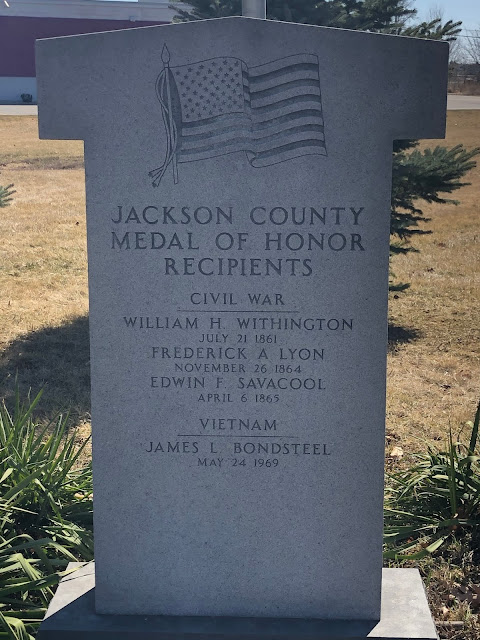
On this year's Medal of Honor Day, I'd like to present the men with a relationship to Jackson County that have received our nation's highest military honor.  Some were born here.  Others came here after their respective conflicts had ended.

Should you follow the links to their respective profiles, you will find dramatically different actions that qualified each man performed that led to their being awarded the Medal of Honor.  I find the actions of SSgt James Bondsteel to be of particular note.

Jackson County (MI) Medal of Honor Monument

Jackson County (MI) Medal of Honor Monument - Detail

Jackson County veterans dedicated our Medal of Honor monument almost a decade ago on Veteran's Day of 2011.  At the time, Blackman Township was looking to rename the former Holiday Inn Drive due to the fact that the Holiday Inn structure had been sold and renamed with the new Holiday Inn being located a few miles away.  The decision to rename the road as Bondsteel Drive was not universally well-received.  One business located on the road objected and on the day of the dedication refused to allow veterans to use their parking lot for the half-hour ceremony.

The four men currently honored on the monument are:

William H. Withington

William H. Withington led one of the first contingents of volunteers to respond to Abraham Lincoln's call for units to serve in the Civil War.  Capt. Withington fought at the First Battle of Bull Run where he saved a fallen Union general and was taken captive.  After being released in a prisoner exchange, Withington returned to Michigan and enlisted in the 17th Michigan Infantry as a Colonel and fought in three major Civil War battles.  He received the Medal of Honor for his actions at Bull Run.

Withington is of particular note in Jackson's history.  He was an industrialist that formed and ran many companies.  The most significant company would eventually be named the Sparton Corporation after Withington and later company executive William Sparks.  The company left Jackson in 2009.

Withington is honored in the area by the city's football field (Withington Community Stadium) as well as a city park that is home to the county's veterans memorial (Withington Park).

Frederick A. Lyon

As a Corporal in the US Army, Federick Lyon halted an ambulance that was part of a general Confederate retreat from the battle of Cedar Creek.  The ambulance happened to be transporting Confederate General Stephen Ramseur and two other officers.  He and a fellow soldier took the group along with the regimental colors prisoner and returned them to the Union side.

Edwin F. Savacool

Captain Savacool fought in the last major battle of the Civil War at Sailor's Creek, VA.  He was one of many who captured the battle colors (and thus the command) of Confederate Units on that day.  He was wounded during the fighting and died nearly two months later.  The Jackson native was originally interred in Marshall, MI but his remains were later relocated to Detroit.  You can read more about Captain Savacool's interesting history here.

James Bondsteel

SSgt Bondsteel was serving with Company A, 2nd Bn, 2nd Infantry, 1st Infantry Div in Vietnam when his unit was called to support another unit that was under fire from an NVA battalion.  During the action, SSgt Bondsteel personally destroyed ten enemy bunkers and one machine gun emplacement.  He was wounded during the four-hour action yet still came to the aid of a wounded officer.  SSgt. Bondsteel refused medical treatment and continued to organize and lead his unit until they were properly relieved.

After the service, Jim Bondsteel became a counselor for the Veterans Administration.  He was killed in a logging truck accident in Alaska where his remains were interred.  He is honored with a memorial at the Alaska Veterans Memorial in the Denali State Park and with the naming of Camp Bondsteel in Kosovo.

Alaska Veterans Memorial Marker

His life was recalled in a 2018 article in the Hillsdale (MI) Daily News.  He is also remembered on a personal website.

Tuesday, March 16, 2021

Physicality - Men and Women

When I served in the Corps back in the day, one of my friends was roughly 5'-6 to 5'-8 and weighed 140-150 lbs.  Another friend who was over 6'-0 had to be in the 220 lbs range.  Neither (to the best of my knowledge) was the second incarnation of Bruce Lee, but they were tough enough.

Put them in a ring and who would you put money on?  

There is a recurring debate about the differences between men and women.  Differences that are driven by biology, genetics, science.  The latest iteration of the debate was kicked off by a Tucker Carlson rant about the military services creating uniforms (including flight suits) for pregnant service members and plans to alter hairstyles for women.

For the record, I don't care about those changes.  I wouldn't want a pilot to be in a dogfight performing high g maneuvers in an F-35 and 8 months pregnant.  It wouldn't be safe for anyone.  Take the same pilot several months later and the situation wouldn't be safe for just one person; the idiot that took their plane off the runway to engage a US pilot - any US pilot - flying our best fighter in the first place.  And hair is just hair.  A hairstyle is fine as long as it doesn't interfere with mission accomplishment.  Women have wanted to wear ponytails and/or braids in uniform for a long while.  Keep it neat, clean, and out of the way and it's fine.

I served with many women who were outstanding Marines.  Tucker's rant was poorly aimed at best.

So what does physical capability have to do with uniform/hair regulations?  Nothing.

But debates over uniforms and hairstyles (and a couple of other topics) inevitably wander into the physical capabilities of men relative to the same capabilities of women.

There is a difference that some people do not want to acknowledge  They will deflect the issue by pointing out women at the upper end of the bell curve such as Rhonda Rousey or Gina Carano.  Again, for the record, I wouldn't have wanted to climb into the ring with either of those women when I was in my prime.  They are indeed at the top end of the bell curve of physical fitness for women.  They individually outclass the majority of men in both physical fitness and fighting ability/preparation.

Let's start with some basics; average height and weight.  Men are, on average, taller and heavier than women.  That gives an advantage in most physical competitions.  The following was taken from the ever-questionable Wikipedia on 16 March 2021.  Note that in every country, the average for men is greater than the average for women.  

Average Human Body Weight - Men vs. Women - Click to Embiggen


Average Human Height - Men vs. Women - Click to Embiggen

Those basic differences create an advantage for men.  A longer arm reach makes it easier to get at an opponent while keeping yourself out of range.  Longer legs create a longer stride for greater speed.  There are other physiological differences such as the impact of testosterone on muscle development.  If I were a doctor or a physiology major, I could list several biological differences between men and women that impact their relative performance in physical competitions, but I'm not either one of those.

What I can do is point you towards measurements of the peak physical performance of men and women.  Judge for yourself.  In almost every category, the record for peak performance is held by a man.  In weight lifting competitions where there are weight classes, the nearest comparison between men and women always shows the man is, pound for pound, able to lift more weight.

[I was looking at swimming data a couple of years ago and did note that there was one category where the top competitor was a woman.  I couldn't find that category recently.  It is certainly possible for a woman to be the best on the planet in a straight physical competition.  Where that is the case, it is an exception that illustrates the rule.]

Again, all of these are from the ever questionable Wikipedia.  Go have a look.

A straight comparison cannot be made in every category in the above competitions.  For example, in speed skating, the men have a 5k relay while the women have a 3k relay.  If you adjust the times/distances to account for the difference, the men were faster over the same distance in almost every category even though they had to perform over a longer distance in actual competition.

I added the "almost" because I didn't check every category with a competitive differential and there probably is one where the women were faster/stronger over a shorter distance.  

A case in point would be Serena Williams.  Let's face it, she is the creme de la creme of women's tennis.  She and her sister dominate the sport and have dominated it for decades.  But even she knows that there is a difference between men's and women's tennis.  Andy Murray once challenged her to a match.  Ms. Williams declined.

“If I were to play Andy Murray, I would lose 6-0, 6-0 in five to six minutes, maybe 10 minutes. No, it’s true. It’s a completely different sport. The men are a lot faster and they serve harder, they hit harder, it’s just a different game.”

Why would she say such a thing?  Well she, and her sister had some experience playing against men.  In 1998, they played a set against Karsten Braasch who was, at the time, ranked roughly 200 in men's tennis.  He beat Serena 6-1 and then beat Venus 6-2.  Serena finished the 1998 WTA season ranked 20th in the world.  Venus finished the season ranked 5th.

I am well aware that my personal tennis game sucks.  Don't bother going there.

The larger point is that while the bell curve of the physical performance of women largely overlaps the bell curve for men, it is not the same curve.  The average of the performance curve for men is somewhat above that for women.  The top-end tail of the curve for men generally extends beyond the same tail for women.  Those non-trivial differences are driven by biology, genetics, science.

Physical differences do not make men smarter, more moral, better leaders, or otherwise more qualified than women.  But there is a documented differential in physical performance between men and women just the same.

There are times where that difference might mean the difference between life and death.  

The US Army recently created a gender-neutral combat fitness test.  The result was that 10% of male US Army soldiers failed the test while 65% of female US Army soldiers failed the test.  A passing score is 360 out of 600 points.  The average score for female soldiers was roughly 100 points below the average for male soldiers.  As the results from the test impact promotion eligibility, the US Army is now reconsidering whether or not to have different scales/tests for men and women.

The point?

Men and women are different.  

Biologically.

Genetically.

Measurably.

Scientifically.

Documented.

Most of the world understands this truth.  This post is for those occasions when I run into the rare person that has a tough time accepting this reality.

----

A later update.  I ran across this graph a while back via the /dataisbeautiful group on Reddit.

They did a study of the grip strength of men and women of all ages, sizes, abilities, etc.  The net result was that men had a grip strength that was almost uniformly stronger than women of their cohort.  Grip strength is a reasonable proxy for overall strength. 

Methodology and some additional clarifications to the data at the link.  


Friday, March 5, 2021

Review: The Sword of Kaigen

The Sword of KaigenThe Sword of Kaigen by M.L. Wang
My rating: 5 of 5 stars

This story takes place in a decidedly Asian setting. Character names frequently evoke a Japanese culture.

The story centers around an influential family that runs part of an empire. Their clan, the Matsura, has long been known for their fighting prowess. However, they are also quite provincial; preferring to stay close to their mountain and quietly run things.

Young Mamoru is trying to be worthy of his family's reputation by learning their fighting style. His mother, Misaki, had gone away to school at a modern university where she learned to fight. Women were not considered worthy to fight among the Matsura clan. His father is aloof and emotionally remote. Living his life in fulfillment of the role he plays rather than in the enjoyment of his family.

Eventually, conflict comes to their mountain and all of the Matsura must fight. When the battle is won by the narrowest of margins, the Empire comes to wipe away any evidence of the battle. Families are denied the right to mourn as their tradition dictates.

What changes await the Matsura clan at the end of this conflict? Who lives? Who dies? And who learns something new about themselves as well as those around them?

This book offers a number of contrasts; rural vs. urban, men vs. women, old vs. young, individual achievement vs. government policies, tradition vs. change. Just as in real life, there are no easy answers with simple solutions.

This book is a tour de force piece of fantasy fiction. It was the 2020 winner of the Self Published Fantasy Blog Off and establishes M.L. Wang as a force to be reckoned with in genre literature. Miss this book at your own peril.

View all my reviews

Review: Wolfwinter

WolfwinterWolfwinter by Lela E. Buis
My rating: 3 of 5 stars

I picked up this book because a story by Lela Buis is included in the collection. All of the stories were entertaining if not precisely the most memorable. If you like werewolf stories, then this book is for you.

View all my reviews

Review: Hazardous Imaginings: The Mondo Book of Politically Incorrect Science Fiction

Hazardous Imaginings: The Mondo Book of Politically Incorrect Science FictionHazardous Imaginings: The Mondo Book of Politically Incorrect Science Fiction by Andrew Fox
My rating: 2 of 5 stars

This book is billed as being the intellectual child of Harlan Ellison's "Dangerous Visions". I dropped out after the fourth story.

Essentially, the author was looking for an opportunity to say outrageous things for the purpose of saying outrageous things rather than to provoke readers to consider different perspectives.

Things started going decidedly downhill when the fourth story suggested that Christopher Columbus sailed west across the Atlantic to prove the world was round. Not quite. People had known that the world was round for centuries at that point. What was unknown what the planet looked like west of west where it finally meets the east.

It went on from there to set down a contorted storyline where the Jews end up loving Hitler.

See what I mean about being outrageous for the purpose of being outrageous.

The other stories that I read were decent, but not great. Mark this one as a collection with a lot of potential that didn't quite pan out.

View all my reviews

Thursday, February 18, 2021

Socialists Blink - Again

Venezuela has been mired in a death spiral created by socialist policies for decades.  This is not a rhetorical death spiral.  Socialist policies have taken what was one of the great economic success stories in the world and a beacon for Central and South American nations and turned it into a poverty-ravaged nation.  Malnutrition and poor healthcare have resulted in the deaths of thousands upon thousands of Venezuelans.

This result has always been perfectly predictable.

And now the government of Venezuela is taking a step back.  They are turning towards privatization of their economy to help their nation recover from Chavista politics. Now a change made today can always be unmade in the future.  The future for Venezuela could certainly be bright if they aggressively stepped back towards free markets.

This is just the latest example of how the solution to economic issues is free-market capitalism.  Sweden started the move away from socialist madness in the late 1980s and has been bounding forward ever since.  Lady Thatcher crucially set the UK free from such nonsense back then as well.  France recently tried to tax the super-rich only to watch those folks take their money and their economic activity elsewhere.  

Vietnam is a booming free-market economy even though the communists retain control of the government.  India gradually stepped away from an overly regulated system and towards free-markets.  China has made a similar shift away from a centralized economy over the last few decades.  The result of this global shift towards capitalism has been a reduction in the incidence of extreme poverty.

Nothing has done more to lift people out of poverty than free markets.

Welcome to the club, Venezuealans.  We hope you are here to stay.

Reflections Of A Former Dittohead - Rush Limbaugh RIP

July of 1988.  Running down the I-5 in California from MCB Camp Pendleton to MCAS El Toro in a little government-owned pickup truck.  Air conditioning?  Well, the windows roll down.  Radio?  AM only.

That was fine by me as I liked local AM radio stations.  I would listen to the local NPR call-in programs on my runs to El Toro.  A few years later I would be listening to Larry King's late-night radio program while working my second job delivering pizzas for Dominos.

At this point, I was a young Sergeant of Marines making a monthly (give or take) run to El Toro for office supplies*.  I had figured out years earlier that my life was going to depend on the wise actions of the United States Congress.  I had also figured out that the Democrats running the US House and who were periodically in charge of the US Senate were bereft of wisdom.

News reports that praised the latest national programs were frustrating for their lack of consideration for why past national programs had failed.  Equally frustrating was reporting on initiatives that were at best band-aids and at the worst created "unexpected consequences" that could have been predicted by anyone with a lick of common sense.  Such consequences caused problems greater than the initial initiative was intended to solve.  

Problems that would require yet another national program.  Predictably.  You can't just have Congresscritters sitting around doing nothing, can you?  [Spoiler - Sí se puede!]

In a sea of AM radio programming that ignorantly advocated for government action, Rush was a surprising breath of fresh air.  I was hooked.  I was a week 1 dittohead.

Fortunately, my various jobs allowed me time to listen to Rush while I was working.  I listened.  I also read.  A lot.  Ask my family.  My original blog was filled with things that I had researched to get the facts to support my positions.  Sometimes my positions changed as a result.

Rush suggested at one point that you have to listen to his show for months in order to understand it.  I would go a little further and suggest that you had to listen to his show for at least a couple of years to understand him.

Listening for just a day or a week isn't nearly enough.  Rush would gently roll a stink bomb down the aisle and then spend days or weeks riffing off of it to make a larger point.

He endorsed Bill Clinton for President in 1992.

For about 5 minutes.

He then denied that he had ever endorsed Mr. Clinton when he came back from the break.  He pointed out that whatever was said, it was in the past and had nothing to do with the current moment.  Rush had crystallized Bill Clinton's character, or lack thereof, in those few minutes.

But you had to listen to his show for months to understand that Rush's message was larger than a 5-minute gag.

Years of listening were needed to get through the showman front that Rush projected during his show.  You had to catch those moments when he would set aside the bravado and the persona and speak from his heart.  He truly wished every person to have the opportunity to experience themselves at their greatest abilities.  He understood that the most important part of that equation was the individual.  No government program is ever going to turn an underachiever into a success if that individual is unwilling to do the work that creates success.  No government program will deny success to an individual that is willing to put in the work to create success; although an awful lot of elected Democrats would like to try.

One of the better examples was his inspiration for Dan's Bake Sale.  Back in the day, Rush had a newsletter.  It cost $24 per year.  I didn't subscribe.  This guy "Dan" calls from Fort Collins, CO.  He says that he can't afford it, and would Rush just give him a subscription.

At the time, schools were holding bake sales for the ostensible purpose of raising money to fund schools.  Bill Clinton clucked his tongue over the tragedy of schools holding bake sales.  Eventually, some of the proceeds from those bake sales were sent to Bill Clinton because "Bill Clinton will fund schools".  Spoiler - Mr. Clinton kept the money and school funding wasn't changed.

Rush handed Dan a golden ticket.  He said "hold a bake sale" suggesting that he could raise enough money to purchase a subscription.  Essentially, do the work to earn the money and the subscription will be worth all that much more to you.

Dan from Fort Collins did just that.  And dittoheads jumped in.  With that kind of national exposure, everyone that was close to Fort Collins, and a great many who were not, wanted to participate.  Restauranteurs from New Orleans called Dan to see about setting up a booth so they could sell food.  The event exploded.

Dan sold out of cookies in no time flat.  He purchased his subscription.  And tens of thousands of people had a great day in Fort Collins, CO.  Imagine if Dan had stopped worrying about just selling cookies.  

Being handed a golden ticket is not a guarantee of success.  It is an opportunity.  What happens after that is up to the individual.

A second example would be the current Fox News personality, Tammy Bruce.  Tammy started out in radio broadcasting as a left-leaning feminist.  She was told that Rush was an awful person.  Then she met him and found out who he really was.  Her story is worth reading.

I stopped being a regular listener in roughly 2002 for a couple of reasons.  His bits didn't always land well.  A few years earlier he had done a bit about the dog that lived in the Whitehouse.  Chelsea Clinton's photo was used in the bit.  While few things were off-limits to Rush, this one should have been.  There were other examples.

By 2002 it was apparent that Rush was unwilling to pursue the fiscal conservativism that he had been preaching for roughly 15 years when Republicans had the majority in the House and Senate as well as a Republican as President.  The GOP in Congress was attempting to spend money like drunken sailors on shore leave.  Apologies to my Squiddly Diddly friends.  (Less than a decade later, Democrat politicians said "hold my beer".)  Rush elected not to criticize political friends over issues that he would regularly criticize politicians on the left.

Rush didn't hold the feet of elected Republicans to the fire.  We didn't get a balanced budget.  We didn't get any meaningful reduction in the number of federal agencies, departments, and assorted conclaves.

If he was unwilling to advocate for the same principles when his allies were in office and positioned to actually achieve those objectives, then perhaps my time was better spent elsewhere.  I have only listened to his show a few times a year since that time.

I've listened a little more frequently over the last year.  Rush announced that he had stage 4 lung cancer last January.  Every show might be his last.

I just happened to catch a show where he was in the studio just after Christmas.

Roughly half the nation is feeling hurt, bemoaning the coming Biden Presidency, caught up in all of the conflict raised in the wake of the election.

Rush reached for confidence.  He spoke of his love for America.  He expressed humble gratitude for the opportunities that he has received by living in a nation that stands for individual liberty.  He supported perseverance and opposed violent "revolution".

Rush happily advocated for doing the difficult work needed to foster an American vision of liberty that is rooted in our Constitution.  Making such a vision a reality would be sweeter for having done the right work rather than taking destructive shortcuts.

Rush Limbaugh knew that death walked but a few paces behind and chose to cheerfully encourage the rest of us to be better people in pursuit of better ends.

He long ago set my inquisitive mind free from the constraints imposed by media bias and popular culture.  This opportunity to consider all of the political options was his gift to me.  I hope when I die that others will not see that as a wasted opportunity.

Fair winds and following seas, Rush.  


*Those damned asterisks.  In the 1980s, there was no such thing as the Internet.  Military organizations couldn't just go to an office supply store for pens, paper, tape, etc.  A central organization bought such stuff and units were tasked with sending someone to get what was needed.  Office supplies were kept in a locked area to prevent pilfering.  It was my part-time job as an expediter.

Now the astute observer would note that MCB Camp Pendleton is located at the north end of San Diego County in California and that MCAS El Toro was (formerly) located near Irvine, California.  It was roughly a 45-60 minute drive from my command location to the El Toro office supply "store".  Why wouldn't I just go to the "store" on Camp Pendleton?

That would make too much sense.  The problem was that I was in the 3rd Marine Aircraft Wing.  All of our funding flowed through the 3rd MAW.  Thus we were required to shop at the 3rd MAW office supply store.  The stores on Camp Pendleton were operated by the 1st Marine Division or by the base.  Wing units were not a part of either organization.

If you want to know why I mistrust the efficacy of government programs, I can only point to my experiences in the world's finest fighting force; the United States Marine Corps.  Congress mandates that the Corps operate according to rules that make Calvinball seem to make sense.  

And the American military is the most effective part of the US government!